
Pearson+ LogoPearson+ Logo
Ch.23 Lipids
McMurry - Fundamentals of GOB 8th Edition
McMurry8th EditionFundamentals of GOBISBN: 9780134015187Not the one you use?Change textbook
Chapter 23, Problem 50

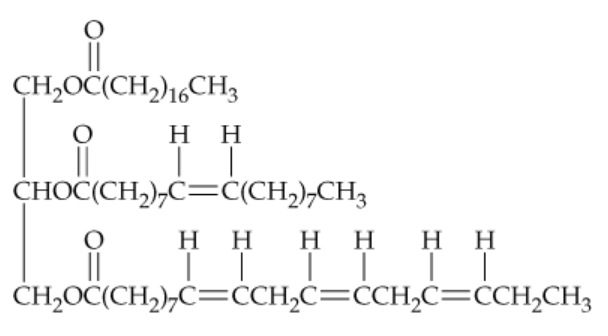
Draw the structure of the product you would obtain on complete hydrogenation of the triacylglycerol in Problem 23.49. What is its name? Does it have a higher or lower melting temperature than the original triacylglycerol?
Chemical structure of triacylglycerol showing hydrogenation with bonds and functional groups labeled.

Verified step by step guidance
1
Identify the structure of the original triacylglycerol. A triacylglycerol consists of a glycerol backbone esterified with three fatty acid chains. These fatty acid chains may contain double bonds (unsaturated) or no double bonds (saturated).
Understand the process of complete hydrogenation. During hydrogenation, all double bonds in the unsaturated fatty acid chains are converted into single bonds by the addition of hydrogen (H₂) in the presence of a catalyst, such as nickel or platinum.
Draw the structure of the hydrogenated product. Replace all double bonds in the fatty acid chains with single bonds, ensuring that the resulting fatty acid chains are fully saturated. The glycerol backbone remains unchanged.
Name the product. The name of the product will depend on the specific fatty acids present in the original triacylglycerol. After hydrogenation, the fatty acids will be fully saturated, so their names will reflect this (e.g., oleic acid becomes stearic acid).
Compare the melting temperature. Fully saturated triacylglycerols have a higher melting temperature than their unsaturated counterparts because saturated fatty acid chains pack more tightly, leading to stronger intermolecular forces (van der Waals interactions).

Verified video answer for a similar problem:

This video solution was recommended by our tutors as helpful for the problem above.
Video duration:
3m
Was this helpful?

Key Concepts

Here are the essential concepts you must grasp in order to answer the question correctly.

Triacylglycerol Structure

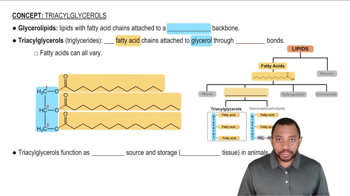
Triacylglycerols, or triglycerides, are esters formed from glycerol and three fatty acids. Their structure consists of a glycerol backbone attached to three long hydrocarbon chains, which can be saturated or unsaturated. The nature of these fatty acids significantly influences the physical properties of the triacylglycerol, including its melting temperature.
Recommended video:
Guided course
1:52
Triacylglycerols Concept 1

Hydrogenation Process

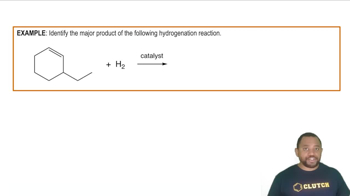
Hydrogenation is a chemical reaction that involves the addition of hydrogen to unsaturated fatty acids, converting double bonds into single bonds. This process typically results in the saturation of the fatty acid chains, leading to a more solid product. Complete hydrogenation of triacylglycerols transforms them into saturated fats, which alters their melting point and physical state.
Recommended video:
Guided course
0:49
Hydrogenation Reactions Example 1

Melting Temperature

The melting temperature of a fat is influenced by its fatty acid composition. Saturated fats, resulting from complete hydrogenation, generally have higher melting temperatures compared to unsaturated fats due to their straight-chain structure, which allows for tighter packing. Understanding the relationship between saturation and melting temperature is crucial for predicting the physical properties of the hydrogenated product.
Recommended video:
Guided course
02:10
Temperature (Simplified) Example 2
Related Practice
Textbook Question

There are two isomeric triacylglycerol molecules whose components are glycerol, one palmitic acid unit, and two stearic acid units. Draw the structures of both, and explain how they differ.

749
views
Textbook Question

Is the reaction shown here esterification, hydrogenation, hydrolysis, saponification, or substitution?

1451
views
Textbook Question

Draw the structures of all products you would obtain by saponification of the following lipid with aqueous KOH. What are the names of the products?

803
views
Textbook Question

Tell how many different products you would obtain on hydrogenation of the triacylglycerol in Problem 23.49 if:

a. One double bond was converted to a single bond

b. Two double bonds were converted to single bonds

c. Three double bonds were converted to single bonds

d. All four double bonds were converted to single bonds

1116
views
Textbook Question

Dietary guidelines suggest we limit our intake of butter due to the cholesterol content and substitute oils or margarine. The following table shows the major fatty acid distribution for a typical stick of margarine and also for butter. Values are percentages.

a. Which contains more monounsaturated fatty acids?

654
views
Textbook Question

Dietary guidelines suggest we limit our intake of butter due to the cholesterol content and substitute oils or margarine. The following table shows the major fatty acid distribution for a typical stick of margarine and also for butter. Values are percentages.

c. Which is likely to contain fewer trans-fatty acids

644
views