
Pearson+ LogoPearson+ Logo
Ch.23 Lipids
McMurry - Fundamentals of GOB 8th Edition
McMurry8th EditionFundamentals of GOBISBN: 9780134015187Not the one you use?Change textbook
Chapter 23, Problem 49

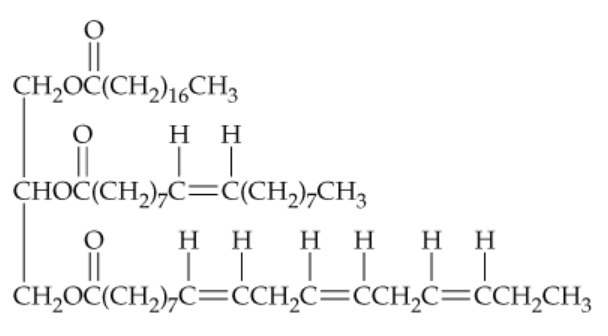
Draw the structures of all products you would obtain by saponification of the following lipid with aqueous KOH. What are the names of the products?
Chemical structure of a triacylglycerol showing bonds and functional groups for hydrolysis reactions.

Verified step by step guidance
1
Identify the type of lipid in the problem. Lipids that undergo saponification are typically triglycerides (triacylglycerols), which consist of a glycerol backbone esterified to three fatty acid chains.
Understand the saponification reaction. Saponification is the base-catalyzed hydrolysis of esters. In this case, the ester bonds in the lipid will be broken by aqueous KOH, producing glycerol and the potassium salts of the fatty acids.
Break down the lipid structure. For each ester bond in the triglyceride, replace the ester group with a hydroxyl group (-OH) on the glycerol backbone, and form a carboxylate ion (-COO⁻) for each fatty acid chain. The carboxylate ions will pair with K⁺ ions to form potassium salts of the fatty acids.
Draw the structures of the products. The first product is glycerol, which has the structure CH₂OH-CHOH-CH₂OH. The second set of products are the potassium salts of the fatty acids, which depend on the specific fatty acid chains present in the original lipid.
Name the products. The names of the products include 'glycerol' for the glycerol backbone and the names of the potassium salts of the fatty acids, which are derived from the names of the original fatty acids (e.g., potassium palmitate, potassium stearate, etc., depending on the fatty acid chains in the lipid).

Verified video answer for a similar problem:

This video solution was recommended by our tutors as helpful for the problem above.
Video duration:
5m
Was this helpful?

Key Concepts

Here are the essential concepts you must grasp in order to answer the question correctly.

Saponification

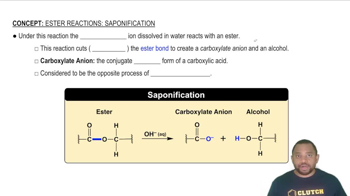
Saponification is a chemical reaction that occurs when a lipid, typically a triglyceride, reacts with a strong base like potassium hydroxide (KOH). This process breaks down the ester bonds in the lipid, resulting in the formation of glycerol and fatty acid salts, commonly known as soap. Understanding this reaction is crucial for predicting the products formed from specific lipids.
Recommended video:
Guided course
1:25
Ester Reactions: Saponification Concept 1

Lipids

Lipids are a diverse group of hydrophobic organic compounds, including fats, oils, and waxes, that are insoluble in water but soluble in organic solvents. They play essential roles in biological systems, such as energy storage, cellular structure, and signaling. Recognizing the type of lipid involved in the saponification process is vital for determining the specific products generated.
Recommended video:
Guided course
1:28
Intro to Lipids Example 1

Fatty Acids

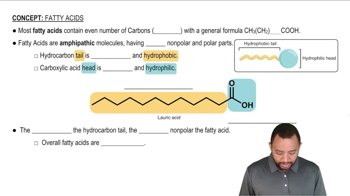
Fatty acids are carboxylic acids with long hydrocarbon chains, which can be saturated or unsaturated. During saponification, the fatty acids released from triglycerides can vary in chain length and degree of saturation, influencing the properties of the resulting soap. Identifying the specific fatty acids produced is important for understanding the characteristics of the final products.
Recommended video:
Guided course
2:00
Fatty Acids Concept 1