
Pearson+ LogoPearson+ Logo
Ch.23 Lipids
McMurry - Fundamentals of GOB 8th Edition
McMurry8th EditionFundamentals of GOBISBN: 9780134015187Not the one you use?Change textbook
Chapter 23, Problem 60

Show the structure of a cerebroside made up of D-galactose, sphingosine, and myristic acid.

Verified step by step guidance
1
Understand the components of a cerebroside: Cerebrosides are glycosphingolipids, which means they are composed of a sugar molecule (in this case, d-galactose), a sphingosine backbone, and a fatty acid (here, myristic acid).
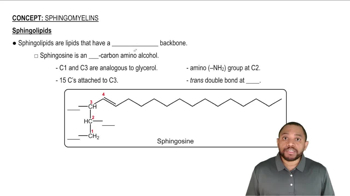
Start with the sphingosine backbone: Sphingosine is an 18-carbon amino alcohol with a long hydrocarbon chain, a hydroxyl group (-OH) at C1, an amino group (-NH2) at C2, and a trans double bond between C4 and C5.
Attach the fatty acid (myristic acid) to the sphingosine: Myristic acid is a 14-carbon saturated fatty acid. It forms an amide bond with the amino group (-NH2) on the C2 of sphingosine. This creates the ceramide portion of the cerebroside.
Add the sugar (d-galactose) to the ceramide: The hydroxyl group (-OH) on C1 of sphingosine is the site of glycosidic bond formation. d-Galactose is attached to this position via a β-glycosidic bond, completing the cerebroside structure.
Verify the structure: Ensure that the final structure includes the sphingosine backbone, the amide bond with myristic acid, and the β-glycosidic bond connecting d-galactose to the sphingosine. This is the complete structure of the cerebroside.

Verified video answer for a similar problem:

This video solution was recommended by our tutors as helpful for the problem above.
Video duration:
5m
Was this helpful?

Key Concepts

Here are the essential concepts you must grasp in order to answer the question correctly.

Cerebrosides

Cerebrosides are a type of glycosphingolipid that consist of a sphingosine backbone, a fatty acid, and a monosaccharide. They play crucial roles in cell membrane structure and function, particularly in the nervous system. The presence of a sugar moiety, such as d-galactose, distinguishes cerebrosides from other sphingolipids.

Sphingosine

Sphingosine is an amino alcohol that serves as the backbone for sphingolipids, including cerebrosides. It contains a long hydrocarbon chain and a hydroxyl group, which allows it to form various lipid structures. Sphingosine's unique structure contributes to the stability and functionality of cell membranes.
Recommended video:
Guided course
1:32
Sphingomyelins Concept 1

Fatty Acids

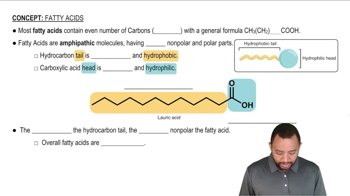
Fatty acids are long hydrocarbon chains with a carboxylic acid group at one end. In the context of cerebrosides, myristic acid, a saturated fatty acid, is attached to the sphingosine backbone. The type and length of the fatty acid influence the physical properties and biological functions of the resulting lipid.
Recommended video:
Guided course
2:00
Fatty Acids Concept 1