
Pearson+ LogoPearson+ Logo
Ch.23 Lipids
McMurry - Fundamentals of GOB 8th Edition
McMurry8th EditionFundamentals of GOBISBN: 9780134015187Not the one you use?Change textbook
Chapter 23, Problem 62

Draw the structure of a glycerophospholipid that contains palmitic acid, oleic acid, and the phosphate bonded to propanolamine.

Verified step by step guidance
1
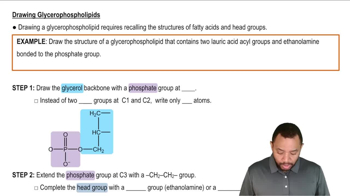
Understand the structure of a glycerophospholipid: A glycerophospholipid consists of a glycerol backbone, two fatty acid chains attached to the first two carbons of glycerol via ester bonds, and a phosphate group attached to the third carbon of glycerol. The phosphate group is further bonded to a polar head group, in this case, propanolamine.
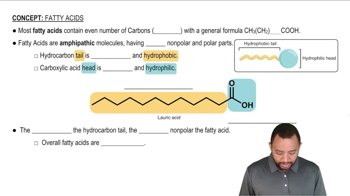
Identify the fatty acids: Palmitic acid is a saturated fatty acid with the formula CH₃(CH₂)₁₄COOH, and oleic acid is a monounsaturated fatty acid with the formula CH₃(CH₂)₇CH=CH(CH₂)₇COOH. These will be esterified to the first and second carbons of the glycerol backbone, respectively.
Attach the fatty acids to the glycerol backbone: Draw the glycerol molecule (a three-carbon chain with hydroxyl groups on each carbon). Attach palmitic acid to the hydroxyl group on the first carbon and oleic acid to the hydroxyl group on the second carbon via ester bonds. This forms the hydrophobic tail region of the glycerophospholipid.
Add the phosphate group and propanolamine: Attach a phosphate group (PO₄³⁻) to the hydroxyl group on the third carbon of the glycerol backbone. Then, bond the phosphate group to the propanolamine head group (CH₂CH₂CH₂NH₂), which is a polar molecule, forming the hydrophilic head region.
Combine all components into the final structure: Ensure the molecule is drawn with the hydrophobic fatty acid tails (palmitic acid and oleic acid) on one side and the hydrophilic phosphate-propanolamine head group on the other side. This amphipathic structure is characteristic of glycerophospholipids.

Verified video answer for a similar problem:

This video solution was recommended by our tutors as helpful for the problem above.
Video duration:
4m
Was this helpful?

Key Concepts

Here are the essential concepts you must grasp in order to answer the question correctly.

Glycerophospholipid Structure

Glycerophospholipids are a class of lipids that consist of a glycerol backbone, two fatty acid tails, and a phosphate group. The glycerol serves as the central framework, while the fatty acids can vary in length and saturation, influencing the fluidity and function of cell membranes. Understanding this structure is essential for drawing the specific glycerophospholipid requested in the question.
Recommended video:
Guided course
2:32
Glycerophospholipids Example 3

Fatty Acids

Fatty acids are long hydrocarbon chains that can be saturated or unsaturated. Palmitic acid is a saturated fatty acid with 16 carbon atoms, while oleic acid is an unsaturated fatty acid with 18 carbon atoms and one double bond. The specific combination of these fatty acids in the glycerophospholipid affects its properties, such as membrane fluidity and permeability.
Recommended video:
Guided course
2:00
Fatty Acids Concept 1

Phosphate Group and Propanolamine

The phosphate group in glycerophospholipids is crucial for their role in cell membranes, as it provides a hydrophilic (water-attracting) head that interacts with the aqueous environment. When bonded to propanolamine, a small amine, it forms a specific head group that can influence the lipid's charge and interactions with other molecules. This understanding is vital for accurately depicting the complete structure of the glycerophospholipid.
Recommended video:
Guided course
2:26
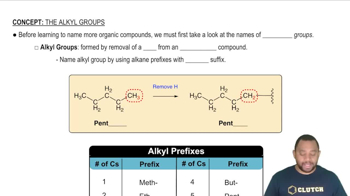
Alkyl Groups Concept 1