Pearson+ LogoPearson+ Logo
Ch.23 Lipids
McMurry - Fundamentals of GOB 8th Edition
McMurry8th EditionFundamentals of GOBISBN: 9780134015187Not the one you use?Change textbook
Chapter 23, Problem 63

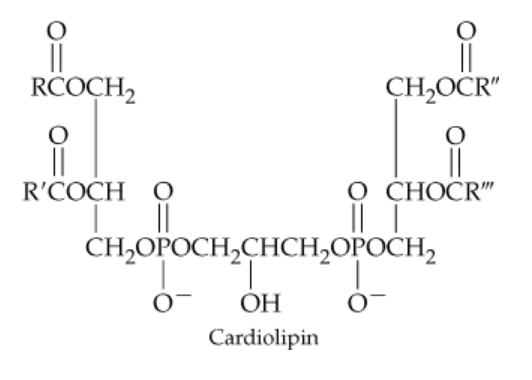
Cardiolipin, a compound found in heart muscle, has the following structure. What products are formed if all ester bonds in the molecule are saponified by treatment with aqueous NaOH?
Structural representation of cardiolipin, highlighting its ester bonds and potential products from saponification with NaOH.

Verified step by step guidance
1
Identify the functional groups in the cardiolipin molecule. Cardiolipin contains ester bonds, which are formed by the reaction of carboxylic acids and alcohols.
Understand the process of saponification. Saponification is the hydrolysis of ester bonds in the presence of a strong base, such as NaOH, resulting in the formation of a carboxylate salt and an alcohol.
Analyze the structure of cardiolipin. Each ester bond in the molecule will undergo saponification, breaking the bond between the oxygen atom of the ester and the carbonyl carbon.
Determine the products of saponification. For each ester bond, the carboxylic acid portion will form a carboxylate ion (due to the reaction with NaOH), and the alcohol portion will be released as a free alcohol molecule.
Count the number of ester bonds in the cardiolipin molecule. Based on the structure, identify how many carboxylate ions and alcohol molecules will be produced as a result of the saponification reaction.

Verified video answer for a similar problem:

This video solution was recommended by our tutors as helpful for the problem above.
Video duration:
3m
Was this helpful?

Key Concepts

Here are the essential concepts you must grasp in order to answer the question correctly.

Saponification

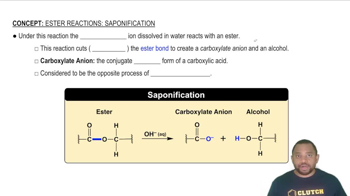
Saponification is a chemical reaction that occurs when a fat or oil is treated with a strong base, such as sodium hydroxide (NaOH). This process breaks the ester bonds in triglycerides or phospholipids, resulting in the formation of glycerol and fatty acid salts, commonly known as soap. Understanding this reaction is crucial for predicting the products formed when cardiolipin undergoes saponification.
Recommended video:
Guided course
1:25
Ester Reactions: Saponification Concept 1

Cardiolipin Structure

Cardiolipin is a unique phospholipid composed of two phosphatidic acid molecules linked by a glycerol backbone. It is primarily found in the inner mitochondrial membrane and plays a vital role in mitochondrial function. Familiarity with its structure, including the presence of multiple ester bonds, is essential for understanding how saponification will affect the molecule.
Recommended video:
Guided course
1:01
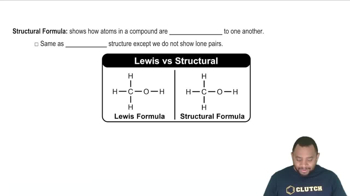
Structural Formula Concept 2

Aqueous NaOH

Aqueous sodium hydroxide (NaOH) is a strong base commonly used in chemical reactions, including saponification. In an aqueous solution, NaOH dissociates into sodium ions and hydroxide ions, which are responsible for breaking the ester bonds in lipids. Recognizing the role of NaOH in facilitating the saponification process is important for predicting the resulting products from cardiolipin.
Recommended video:
Guided course
01:29
Solutions: Mass Percent Concept 1