Pearson+ LogoPearson+ Logo
Ch.26 Nucleic Acids and Protein Synthesis
McMurry - Fundamentals of GOB 8th Edition
McMurry8th EditionFundamentals of GOBISBN: 9780134015187Not the one you use?Change textbook
Chapter 26, Problem 71

Insulin is synthesized as preproinsulin, which has 81 amino acids. How many heterocyclic bases must be present in the informational DNA strand to code for preproinsulin (assuming no introns are present)?

Verified step by step guidance
1
Understand the relationship between amino acids and DNA codons: Each amino acid in a protein is coded for by a sequence of three nucleotides (a codon) in the DNA. This means that for every amino acid, there are three nucleotides required in the DNA sequence.
Determine the total number of amino acids in preproinsulin: The problem states that preproinsulin consists of 81 amino acids.
Calculate the total number of nucleotides required: Multiply the number of amino acids (81) by the number of nucleotides per codon (3). Use the formula: n=81×3, where n is the total number of nucleotides.
Recognize that each nucleotide corresponds to a heterocyclic base: The four heterocyclic bases in DNA are adenine (A), thymine (T), cytosine (C), and guanine (G). Therefore, the total number of nucleotides calculated in the previous step is equal to the number of heterocyclic bases required.
Conclude that the total number of heterocyclic bases required is equal to the total number of nucleotides calculated in step 3. This represents the informational DNA strand needed to code for preproinsulin.

Verified video answer for a similar problem:

This video solution was recommended by our tutors as helpful for the problem above.
Video duration:
1m
Was this helpful?

Key Concepts

Here are the essential concepts you must grasp in order to answer the question correctly.

Genetic Code

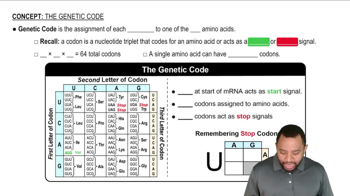
The genetic code is the set of rules by which information encoded in genetic material is translated into proteins. It consists of codons, which are sequences of three nucleotides that correspond to specific amino acids. Understanding the genetic code is essential for determining how many nucleotides are needed to code for a given number of amino acids.
Recommended video:
Guided course
03:25
The Genetic Code Concept 1

Amino Acids and Codons

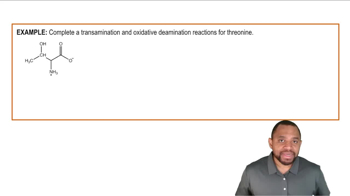
Amino acids are the building blocks of proteins, and each amino acid is encoded by a specific sequence of three nucleotides, known as a codon. Since preproinsulin consists of 81 amino acids, the total number of codons required to code for it can be calculated by multiplying the number of amino acids by three, which is crucial for understanding the DNA sequence needed.
Recommended video:
Guided course
3:03
Amino Acid Catabolism: Amino Group Example 2

DNA Structure

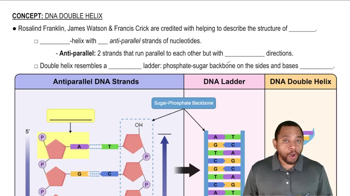
DNA is composed of four nucleotides, which include adenine (A), thymine (T), cytosine (C), and guanine (G). The sequence of these nucleotides encodes genetic information. In the context of the question, understanding the structure of DNA helps in determining how many nucleotides are necessary to code for the preproinsulin protein, as each amino acid corresponds to a specific triplet of these bases.
Recommended video:
Guided course
3:27
DNA Double Helix Concept 1