Pearson+ LogoPearson+ Logo
Ch.26 Nucleic Acids and Protein Synthesis
McMurry - Fundamentals of GOB 8th Edition
McMurry8th EditionFundamentals of GOBISBN: 9780134015187Not the one you use?Change textbook
Chapter 26, Problem 1

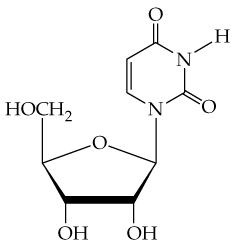
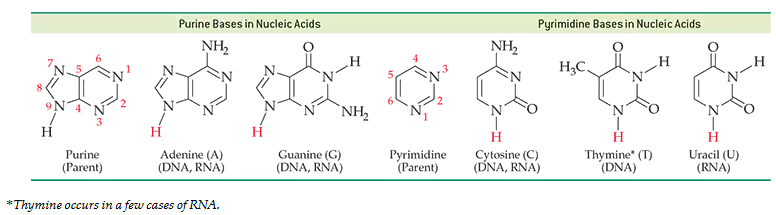
Name the nucleoside shown here. Copy the structure, and number the C and N atoms (refer to Table 26.1).

Verified step by step guidance
1
Identify the components of the nucleoside: A nucleoside consists of a nitrogenous base (a purine or pyrimidine) attached to a sugar molecule (ribose or deoxyribose) via a β-N-glycosidic bond. Examine the structure in the image to determine the type of nitrogenous base and sugar present.
Number the carbon (C) atoms in the sugar: For ribose or deoxyribose, start numbering from the carbon attached to the nitrogenous base (this is C1'). Continue numbering the carbons in the sugar clockwise, ending with C5'.
Number the nitrogen (N) and carbon (C) atoms in the nitrogenous base: Refer to Table 26.1 or a standard numbering scheme for purines and pyrimidines. For purines, start numbering at the nitrogen atom in the six-membered ring closest to the sugar. For pyrimidines, start numbering at the nitrogen atom directly bonded to the sugar.
Combine the names of the sugar and the nitrogenous base: Use the name of the nitrogenous base (e.g., adenine, cytosine, guanine, thymine, or uracil) and the type of sugar (ribose or deoxyribose) to name the nucleoside. For example, if the base is adenine and the sugar is ribose, the nucleoside is adenosine.
Verify the structure and naming: Double-check the numbering of atoms and the name of the nucleoside to ensure accuracy. Ensure that the β-N-glycosidic bond is correctly represented in the structure.

Verified video answer for a similar problem:

This video solution was recommended by our tutors as helpful for the problem above.
Video duration:
1m
Was this helpful?

Key Concepts

Here are the essential concepts you must grasp in order to answer the question correctly.

Nucleosides

Nucleosides are organic molecules composed of a nitrogenous base attached to a sugar molecule, specifically ribose or deoxyribose. They are fundamental building blocks of nucleic acids, such as DNA and RNA. Understanding the structure of nucleosides is crucial for identifying them, as the specific arrangement of atoms and functional groups determines their classification and function.
Recommended video:
Guided course
1:21
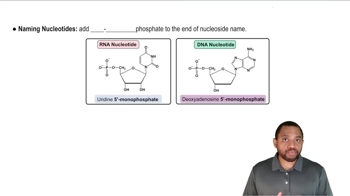
Naming Nucleosides and Nucleotides Concept 2

Numbering of Atoms

In organic chemistry, numbering atoms in a molecular structure is essential for clear communication and understanding of the compound's configuration. For nucleosides, the carbon (C) and nitrogen (N) atoms are typically numbered in a specific order, which helps in identifying the position of functional groups and understanding the molecule's reactivity. This systematic approach is vital for accurately describing the structure and for referencing in scientific literature.
Recommended video:
Guided course
02:42
Calculate Oxidation Numbers

Structural Representation

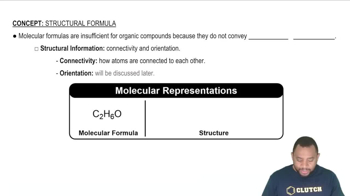
Structural representation refers to the way a molecule is depicted, showing the arrangement of atoms and the bonds between them. In the context of nucleosides, this includes the depiction of the sugar and base components, as well as the specific connectivity of atoms. Accurately copying and numbering the structure is important for identifying the nucleoside and for further studies in biochemistry and molecular biology.
Recommended video:
Guided course
2:08
Molecular Representations Concept 1