Pearson+ LogoPearson+ Logo
Ch.11 Introduction to Organic Chemistry: Hydrocarbons
Timberlake - Chemistry: An Introduction to General, Organic, and Biological Chemistry 14th Edition
Timberlake14thChemistry: An Introduction to General, Organic, and Biological ChemistryISBN: 9781292472249Not the one you use?Change textbook
Chapter 11, Problem 19d

Heptane, used as a solvent for rubber cement, has a density of 0.68 g/mL, the melting point is -91 °C, and the boiling point 98 °C.
d. Will heptane float on water or sink?

Verified step by step guidance
1
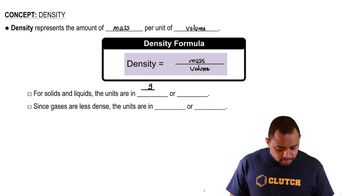
Step 1: Understand the concept of density and its role in determining whether a substance will float or sink in water. Density is defined as mass per unit volume (g/mL). If the density of a substance is less than the density of water (approximately 1.00 g/mL), the substance will float. If it is greater, the substance will sink.
Step 2: Identify the density of heptane from the problem. The density of heptane is given as 0.68 g/mL.
Step 3: Compare the density of heptane (0.68 g/mL) to the density of water (1.00 g/mL). Since 0.68 g/mL is less than 1.00 g/mL, heptane is less dense than water.
Step 4: Based on the comparison, substances that are less dense than water will float on water. Therefore, heptane is expected to float.
Step 5: Conclude that heptane will float on water due to its lower density compared to water.

Verified video answer for a similar problem:

This video solution was recommended by our tutors as helpful for the problem above.
Was this helpful?

Key Concepts

Here are the essential concepts you must grasp in order to answer the question correctly.

Density

Density is defined as mass per unit volume, typically expressed in grams per milliliter (g/mL) for liquids. A substance will float on a liquid if its density is less than that of the liquid. In this case, heptane has a density of 0.68 g/mL, which is lower than the density of water (approximately 1.00 g/mL), indicating that heptane will float.
Recommended video:

Buoyancy

Buoyancy is the upward force exerted by a fluid that opposes the weight of an object immersed in it. This principle explains why objects with lower density than the fluid will float, while those with higher density will sink. Heptane's buoyancy in water is determined by its density relative to water, supporting the conclusion that it will float.

Phase Changes

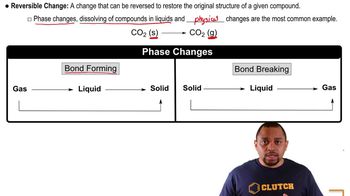
Phase changes refer to the transitions between solid, liquid, and gas states of matter, influenced by temperature and pressure. Heptane's melting point of -91 °C and boiling point of 98 °C indicate that it remains a liquid at room temperature. Understanding these phase changes helps contextualize heptane's behavior in different environments, including its interaction with water.
Recommended video:
Guided course
03:40
Physical & Chemical Changes