Pearson+ LogoPearson+ Logo
Ch.18 Metabolic Pathways and ATP Production
Timberlake - Chemistry: An Introduction to General, Organic, and Biological Chemistry 14th Edition
Timberlake14thChemistry: An Introduction to General, Organic, and Biological ChemistryISBN: 9781292472249Not the one you use?Change textbook
Chapter 18, Problem 5

A person bicycles vigorously and uses 510 kcal. How many moles of ATP are used to provide this amount of energy?

Verified step by step guidance
1
Understand the relationship between energy and ATP: Each mole of ATP releases approximately 7.3 kcal of energy when hydrolyzed to ADP and inorganic phosphate.
Identify the total energy used: The problem states that the person uses 510 kcal of energy.
Set up the conversion: To find the number of moles of ATP used, divide the total energy used (510 kcal) by the energy released per mole of ATP (7.3 kcal/mol). Use the formula: 510kcal7.3kcal/mol.
Perform the division: This will give the number of moles of ATP required to provide 510 kcal of energy.
Interpret the result: The calculated value represents the number of moles of ATP used during vigorous bicycling to supply the given energy.

Key Concepts

Here are the essential concepts you must grasp in order to answer the question correctly.

Energy Conversion in Metabolism

In biological systems, energy from food is converted into usable forms through metabolic pathways. During vigorous exercise, such as cycling, the body primarily relies on aerobic respiration to convert glucose into ATP, the energy currency of the cell. Understanding this conversion is crucial for calculating how much ATP is generated from a specific energy expenditure.
Recommended video:
Guided course
03:45
Conversion Factors (Simplified) Example 2

ATP Yield from Glucose

The complete oxidation of one mole of glucose through cellular respiration yields approximately 30 to 32 moles of ATP. This yield is essential for determining how many moles of ATP can be produced from a given amount of energy, as each mole of ATP corresponds to a specific amount of energy (about 7.3 kcal). This relationship allows for the conversion of kcal used during exercise into moles of ATP.
Recommended video:
Guided course
2:21
Total Energy From Glucose Example 1

Caloric Value of ATP

Each mole of ATP provides about 7.3 kcal of energy when hydrolyzed. To find out how many moles of ATP are used for a specific energy expenditure, such as the 510 kcal mentioned, one must divide the total energy used by the energy yield per mole of ATP. This calculation is fundamental in understanding the efficiency of energy use during physical activities.
Recommended video:
Guided course
2:20
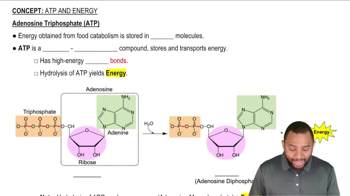
Adenosine Triphosphate (ATP) Concept 2