Pearson+ LogoPearson+ Logo
Ch.18 Metabolic Pathways and ATP Production
Timberlake - Chemistry: An Introduction to General, Organic, and Biological Chemistry 14th Edition
Timberlake14thChemistry: An Introduction to General, Organic, and Biological ChemistryISBN: 9781292472249Not the one you use?Change textbook
Chapter 18, Problem 98e

Which of the following molecules will produce the most ATP per mole?
e. 𝛼-ketoglutarate or fumarate in one turn of the citric acid cycle

Verified step by step guidance
1
Understand the context of the problem: The citric acid cycle (also known as the Krebs cycle) is a metabolic pathway that generates ATP, NADH, and FADH₂ through the oxidation of acetyl-CoA. The question asks which molecule, 𝛼-ketoglutarate or fumarate, produces the most ATP per mole in one turn of the cycle.
Recall the role of each molecule in the citric acid cycle: 𝛼-ketoglutarate is converted to succinyl-CoA via oxidative decarboxylation, producing NADH. Fumarate is formed later in the cycle from succinate and does not directly produce NADH or FADH₂ during its formation.
Consider the energy yield of each step: NADH and FADH₂ are electron carriers that contribute to ATP production during oxidative phosphorylation. The conversion of 𝛼-ketoglutarate to succinyl-CoA generates NADH, which can lead to ATP production. Fumarate itself does not directly generate NADH or FADH₂ but is involved in subsequent steps that may produce these carriers.
Compare the ATP yield: Since 𝛼-ketoglutarate produces NADH during its conversion to succinyl-CoA, it contributes more to ATP production compared to fumarate, which does not directly produce NADH or FADH₂.
Conclude the reasoning: Based on the energy yield of the citric acid cycle, 𝛼-ketoglutarate will produce more ATP per mole than fumarate in one turn of the cycle due to its role in generating NADH.

Verified video answer for a similar problem:

This video solution was recommended by our tutors as helpful for the problem above.
Video duration:
4m
Was this helpful?

Key Concepts

Here are the essential concepts you must grasp in order to answer the question correctly.

Citric Acid Cycle

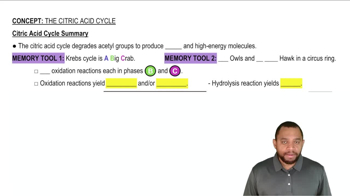
The citric acid cycle, also known as the Krebs cycle, is a series of enzymatic reactions that occur in the mitochondria, where acetyl-CoA is oxidized to produce energy. This cycle generates high-energy electron carriers, NADH and FADH2, which are crucial for ATP production in the electron transport chain. Understanding the cycle's steps and the molecules involved is essential for determining ATP yield.
Recommended video:
Guided course
2:31
Citric Acid Cycle Summary Concept 12

ATP Yield from Metabolites

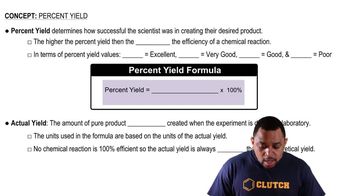
Different metabolites yield varying amounts of ATP when they enter the citric acid cycle. For instance, α-ketoglutarate and fumarate are intermediates that can be converted into energy, but their ATP yield differs based on the number of NADH and FADH2 produced during their conversion. Analyzing these differences is key to answering the question about which molecule produces more ATP.
Recommended video:
Guided course
03:09
Percent Yield

Oxidative Phosphorylation

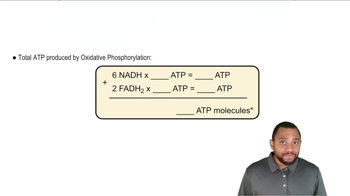
Oxidative phosphorylation is the process by which ATP is produced in the mitochondria using the energy derived from the electron transport chain. The NADH and FADH2 generated in the citric acid cycle donate electrons to this chain, leading to the production of ATP. Understanding how these processes interconnect helps in evaluating the total ATP yield from different substrates in cellular respiration.
Recommended video:
Guided course
0:51
Oxidative Phosphorylation Concept 2