Pearson+ LogoPearson+ Logo
Ch.6 Ionic and Molecular Compounds
Timberlake - Chemistry: An Introduction to General, Organic, and Biological Chemistry 14th Edition
Timberlake14thChemistry: An Introduction to General, Organic, and Biological ChemistryISBN: 9781292472249Not the one you use?Change textbook
Chapter 6, Problem 93a

How does the octet rule explain the formation of a magnesium ion?

Verified step by step guidance
1
The octet rule states that atoms tend to gain, lose, or share electrons to achieve a stable electron configuration with eight valence electrons, similar to the nearest noble gas.
Magnesium (Mg) is in Group 2 of the periodic table and has an electron configuration of 1s² 2s² 2p⁶ 3s². It has two valence electrons in the 3s orbital.
To achieve a stable octet, magnesium can lose its two valence electrons, resulting in a full outer shell (2s² 2p⁶), which matches the electron configuration of neon (Ne), a noble gas.
When magnesium loses two electrons, it forms a positively charged ion, Mg²⁺, because the loss of electrons leaves it with more protons than electrons.
Thus, the octet rule explains the formation of a magnesium ion (Mg²⁺) as the atom loses two electrons to achieve a stable electron configuration similar to a noble gas.

Verified video answer for a similar problem:

This video solution was recommended by our tutors as helpful for the problem above.
Video duration:
3m
Was this helpful?

Key Concepts

Here are the essential concepts you must grasp in order to answer the question correctly.

Octet Rule

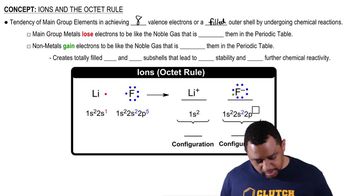
The octet rule is a chemical principle stating that atoms tend to gain, lose, or share electrons to achieve a full outer shell of eight electrons, resembling the electron configuration of noble gases. This rule helps explain the stability of atoms and their tendency to form ions or covalent bonds.
Recommended video:
Guided course
02:59
Ions and the Octet Rule Concept 1

Magnesium Ion Formation

Magnesium, with an atomic number of 12, has two electrons in its outermost shell. To achieve a stable octet configuration, magnesium tends to lose these two valence electrons, resulting in the formation of a positively charged magnesium ion (Mg²⁺). This loss of electrons allows magnesium to attain a stable electron configuration similar to neon.
Recommended video:
Guided course
1:41
Amide Formation Concept 1

Ionic Bonding

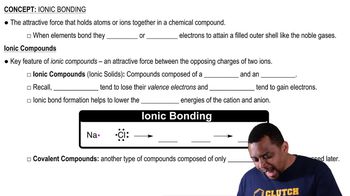
Ionic bonding occurs when atoms transfer electrons to achieve full outer shells, leading to the formation of charged ions. In the case of magnesium, when it loses its two electrons, it can bond with nonmetals like chlorine, which gain electrons, resulting in the formation of ionic compounds such as magnesium chloride (MgCl₂). This process illustrates the practical application of the octet rule in chemical bonding.
Recommended video:
Guided course
02:33
Ionic Bonding Concept 1