Pearson+ LogoPearson+ Logo
Ch.7 Chemical Quantities and Reactions
Timberlake - Chemistry: An Introduction to General, Organic, and Biological Chemistry 14th Edition
Timberlake14thChemistry: An Introduction to General, Organic, and Biological ChemistryISBN: 9781292472249Not the one you use?Change textbook
Chapter 7, Problem 35d

Determine whether each of the following chemical equations is balanced or not balanced:
d. Chemical equation showing propane and oxygen reacting to form carbon dioxide and water, with a symbol indicating heat.

Verified step by step guidance
1
Step 1: Write down the given chemical equation: C₃H₈(g) + 5O₂(g) → 3CO₂(g) + 4H₂O(g).
Step 2: Count the number of carbon (C) atoms on both sides of the equation. On the left side, there are 3 C atoms in C₃H₈. On the right side, there are 3 C atoms in 3CO₂. The carbon atoms are balanced.
Step 3: Count the number of hydrogen (H) atoms on both sides of the equation. On the left side, there are 8 H atoms in C₃H₈. On the right side, there are 8 H atoms in 4H₂O (4 × 2 = 8). The hydrogen atoms are balanced.
Step 4: Count the number of oxygen (O) atoms on both sides of the equation. On the left side, there are 10 O atoms in 5O₂ (5 × 2 = 10). On the right side, there are 6 O atoms in 3CO₂ (3 × 2 = 6) and 4 O atoms in 4H₂O (4 × 1 = 4), for a total of 10 O atoms. The oxygen atoms are balanced.
Step 5: Since the number of each type of atom is the same on both sides of the equation, the chemical equation is balanced.

Verified video answer for a similar problem:

This video solution was recommended by our tutors as helpful for the problem above.
Video duration:
1m
Was this helpful?

Key Concepts

Here are the essential concepts you must grasp in order to answer the question correctly.

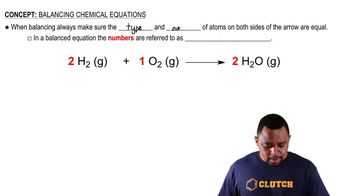
Balancing Chemical Equations

Balancing chemical equations involves ensuring that the number of atoms of each element is the same on both sides of the equation. This is based on the law of conservation of mass, which states that matter cannot be created or destroyed in a chemical reaction. A balanced equation accurately reflects the proportions of reactants and products involved in the reaction.
Recommended video:
Guided course
01:32
Balancing Chemical Equations (Simplified) Concept 1

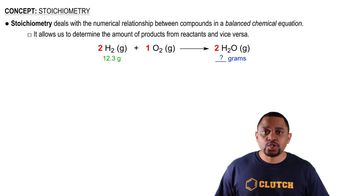
Stoichiometry

Stoichiometry is the calculation of reactants and products in chemical reactions. It uses the coefficients in a balanced equation to determine the relative amounts of substances consumed and produced. Understanding stoichiometry is essential for predicting the outcomes of reactions and for performing quantitative analyses in chemistry.
Recommended video:
Guided course
01:16
Stoichiometry

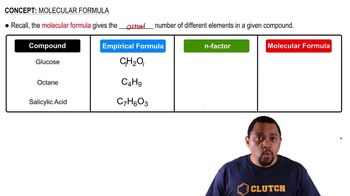
Molecular Formulas

Molecular formulas represent the number and type of atoms in a molecule. For example, C₃H₈ indicates a molecule containing three carbon atoms and eight hydrogen atoms. Recognizing molecular formulas is crucial for identifying the substances involved in a reaction and for ensuring that the equation is balanced by comparing the number of each type of atom on both sides.
Recommended video:
Guided course
02:08
Molecular Formula