Pearson+ LogoPearson+ Logo
Ch.8 Gases
Timberlake - Chemistry: An Introduction to General, Organic, and Biological Chemistry 14th Edition
Timberlake14thChemistry: An Introduction to General, Organic, and Biological ChemistryISBN: 9781292472249Not the one you use?Change textbook
Chapter 8, Problem 54

Suppose a mixture contains helium and oxygen gases. If the partial pressure of helium is the same as the partial pressure of oxygen, what do you know about the number of helium atoms compared to the number of oxygen molecules? Explain.

Verified step by step guidance
1
Step 1: Recall Dalton's Law of Partial Pressures, which states that the total pressure of a gas mixture is the sum of the partial pressures of each individual gas. In this case, the partial pressure of helium is equal to the partial pressure of oxygen.
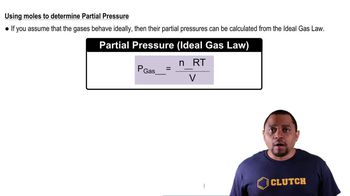
Step 2: Understand the relationship between pressure and the number of gas particles. According to the ideal gas law, \( P = \frac{nRT}{V} \), where \( P \) is pressure, \( n \) is the number of moles, \( R \) is the gas constant, \( T \) is temperature, and \( V \) is volume. If the temperature and volume are constant, the pressure is directly proportional to the number of moles of gas.
Step 3: Recognize that helium exists as individual atoms (He), while oxygen exists as diatomic molecules (O\(_2\)). This means that one mole of helium contains Avogadro's number of helium atoms, and one mole of oxygen contains Avogadro's number of oxygen molecules.
Step 4: Since the partial pressures of helium and oxygen are equal, and pressure is proportional to the number of moles, the number of moles of helium atoms must be equal to the number of moles of oxygen molecules.
Step 5: Conclude that the number of helium atoms is equal to the number of oxygen molecules in the mixture, as the partial pressures are the same and the ideal gas law applies.

Verified video answer for a similar problem:

This video solution was recommended by our tutors as helpful for the problem above.
Video duration:
2m
Was this helpful?

Key Concepts

Here are the essential concepts you must grasp in order to answer the question correctly.

Partial Pressure

Partial pressure refers to the pressure exerted by a single component of a gas mixture. According to Dalton's Law of Partial Pressures, the total pressure of a gas mixture is the sum of the partial pressures of each individual gas. In this scenario, the equal partial pressures of helium and oxygen indicate that the gases are contributing equally to the total pressure, which is crucial for understanding their relative amounts.
Recommended video:
Guided course
00:48
Dalton's Law: Partial Pressure (Simplified) Concept 2

Mole Concept

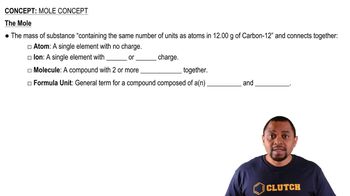
The mole concept is a fundamental principle in chemistry that relates the amount of substance to its number of particles, such as atoms or molecules. One mole of any substance contains Avogadro's number (approximately 6.022 x 10^23) of particles. In the context of the question, knowing the number of moles of helium and oxygen allows us to compare the number of helium atoms to the number of oxygen molecules based on their respective partial pressures.
Recommended video:

Gas Behavior and Ideal Gas Law

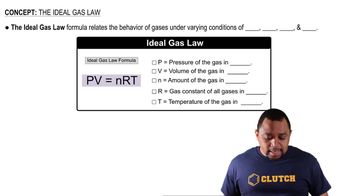
The Ideal Gas Law (PV=nRT) describes the relationship between pressure (P), volume (V), temperature (T), and the number of moles (n) of a gas. It assumes ideal behavior, where gas particles do not interact and occupy no volume. In this case, since the partial pressures of helium and oxygen are equal, it implies that the number of moles of helium must be greater than that of oxygen, as helium is a monatomic gas while oxygen is diatomic, affecting the comparison of their quantities.
Recommended video:
Guided course
01:15
The Ideal Gas Law Concept 1