Pearson+ LogoPearson+ Logo
Ch.9 Solutions
Timberlake - Chemistry: An Introduction to General, Organic, and Biological Chemistry 14th Edition
Timberlake14thChemistry: An Introduction to General, Organic, and Biological ChemistryISBN: 9781292472249Not the one you use?Change textbook
Chapter 9, Problem 11a

Indicate whether aqueous solutions of each of the following solutes contain only ions, only molecules, or mostly molecules and a few ions:
a. acetic acid, HC2H3O2, a weak electrolyte

Verified step by step guidance
1
Identify the type of compound: Acetic acid (HC₂H₃O₂) is a weak acid and a weak electrolyte. Weak electrolytes only partially ionize in water.
Understand the behavior of weak electrolytes in water: When acetic acid dissolves in water, it establishes an equilibrium between its molecular form (HC₂H₃O₂) and its ionized form (H⁺ and C₂H₃O₂⁻).
Write the chemical equilibrium equation for acetic acid in water: HC_2H_3O_2 (aq) ⇌ H^+ (aq) + C_2H_3O_2^- (aq). This shows that only a small fraction of acetic acid molecules ionize.
Determine the predominant species: Since acetic acid is a weak electrolyte, most of the solute remains in the molecular form (HC₂H₃O₂), with only a small fraction existing as ions (H⁺ and C₂H₃O₂⁻).
Conclude the solution type: Aqueous solutions of acetic acid contain mostly molecules and a few ions due to its weak ionization in water.

Verified video answer for a similar problem:

This video solution was recommended by our tutors as helpful for the problem above.
Video duration:
2m
Was this helpful?

Key Concepts

Here are the essential concepts you must grasp in order to answer the question correctly.

Weak Electrolytes

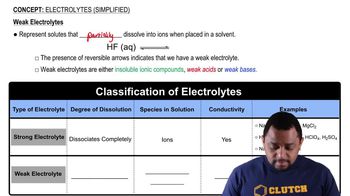
Weak electrolytes are substances that partially dissociate into ions when dissolved in water. Unlike strong electrolytes, which completely ionize, weak electrolytes exist in equilibrium between their molecular form and their ionic form. This means that in a solution of a weak electrolyte, such as acetic acid, there will be a mixture of both ions and un-ionized molecules.
Recommended video:
Guided course
02:33
Electrolytes (Simplified) Concept 2

Dissociation in Aqueous Solutions

Dissociation refers to the process by which a compound separates into its constituent ions in a solvent, typically water. In the case of weak electrolytes, the extent of dissociation is limited, resulting in a solution that contains both ions and undissociated molecules. Understanding the degree of dissociation is crucial for predicting the behavior of solutes in solution.
Recommended video:

Equilibrium in Chemical Reactions

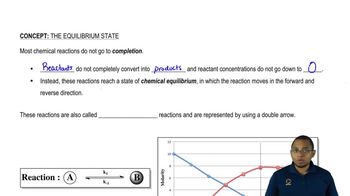
Equilibrium in chemical reactions occurs when the rate of the forward reaction equals the rate of the reverse reaction, leading to constant concentrations of reactants and products. For weak electrolytes like acetic acid, this means that there is a dynamic balance between the dissociated ions and the undissociated molecules, which is essential for understanding the composition of the solution.
Recommended video:
Guided course
03:42
Chemical Equilibrium Concept 1