Indietro
Problema 1.2.79g
Combining Functions
Assume that f is an even function, g is an odd function, and both f and g are defined on the entire real line (−∞,∞). Which of the following (where defined) are even? odd?
g. g ∘ f
Problema 2
Express the radius of a sphere as a function of the sphere’s surface area. Then express the surface area as a function of the volume.
Problema 5
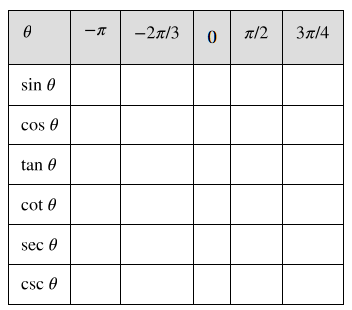
Copy and complete the following table of function values. If the function is undefined at a given angle, enter “UND.” Do not use a calculator or tables.
Problema 14
Graph the functions in Exercises 13–22. What is the period of each function?
sin (x/2)
Problema 21
Graph the functions in Exercises 13–22. What is the period of each function?
sin (x − π/4) + 1
Problema 24
Graph the functions in Exercises 23–26 in the ts-plane (t-axis horizontal, s-axis vertical). What is the period of each function? What symmetries do the graphs have?
s = −tan πt
Problema 27a
[Technology Exercise]
a. Graph y = cos x and y = sec x together for −3π/2 ≤ x ≤ 3π/2. Comment on the behavior of sec x in relation to the signs and values of cos x.
Problema 29
Graph y = sin x and y = ⌊sin x⌋ together. What are the domain and range of ⌊sin x⌋?
Problema 33c
State whether each function is increasing, decreasing, or neither.
c. Height above Earth’s sea level as a function of atmospheric pressure (assumed nonzero)
Problema 33d
State whether each function is increasing, decreasing, or neither.
d. Kinetic energy as a function of a particle’s velocity
Problema 34a
Find the largest interval on which the given function is increasing.
a. ƒ(x) = |x - 2| + 1
Problema 34d
Find the largest interval on which the given function is increasing.
d. R(x) = √ 2x - 1
Problema 39a
Composition of Functions
In Exercises 39 and 40, find
a. (ƒ ○ g) (-1).
ƒ(x) = 1/x , g(x) = 1/√ x + 2
Problema 39d
Composition of Functions
In Exercises 39 and 40, find
d. (g ○ g) (x).
ƒ(x) = 1/x , g(x) = 1/√ x + 2
Problema 41
In Exercises 41 and 42, (a) write formulas for ƒ ○ g and g ○ ƒ and find the (b) domain and (c) range of each.
ƒ(x) = 2 - x², g(x) = √ x + 2
Problema 46
Graph ƒ₁ and ƒ₂ together. Then describe how applying the absolute value function in ƒ₂ affects the graph of ƒ₁.
ƒ₁(x) ƒ₂(x)
x² |x|²
Problema 47
Graph ƒ₁ and ƒ₂ together. Then describe how applying the absolute value function in ƒ₂ affects the graph of ƒ₁.
ƒ₁(x) ƒ₂(x)
x³ |x³|
Problema 49
Graph ƒ₁ and ƒ₂ together. Then describe how applying the absolute value function in ƒ₂ affects the graph of ƒ₁.
ƒ₁(x) ƒ₂(x)
4 - x² |4 - x²|
Problema 51
Graph ƒ₁ and ƒ₂ together. Then describe how applying the absolute value function in ƒ₂ affects the graph of ƒ₁.
ƒ₁(x) ƒ₂(x)
__ ___
√ x √ |x|
Problema 53e
Shifting and Scaling Graphs
Suppose the graph of g is given. Write equations for the graphs that are obtained from the graph of g by shifting, scaling, or reflecting, as indicated.
e. Stretch vertically by a factor of 5
Problema 53f
Shifting and Scaling Graphs
Suppose the graph of g is given. Write equations for the graphs that are obtained from the graph of g by shifting, scaling, or reflecting, as indicated.
f. Compress horizontally by a factor of 5
Problema 54
For Exercises 51–54, solve for the angle θ, where 0 ≤ θ ≤ 2π.
cos 2θ + cos θ = 0
Problema 54a
Describe how each graph is obtained from the graph of 𝔂 = ƒ(x).
a. 𝔂 = ƒ(x - 5)
Problema 54d
Describe how each graph is obtained from the graph of 𝔂 = ƒ(x).
d. 𝔂 = ƒ(2x + 1)
Problema 54e
Describe how each graph is obtained from the graph of 𝔂 = ƒ(x).
e. 𝔂 = ƒ( x ) - 4
3
Problema 55
In Exercises 55–58, graph each function, not by plotting points, but by starting with the graph of one of the standard functions presented in Figures 1.15–1.17, and applying an appropriate transformation.
y = - √(1 + x/2)
Problema 56
Derive a formula for tan (A − B).
Problema 58a
Apply the formula for cos (A − B) to the identity sin θ = cos (π/2 − θ) to obtain the addition formula for sin (A + B).
Problema 61
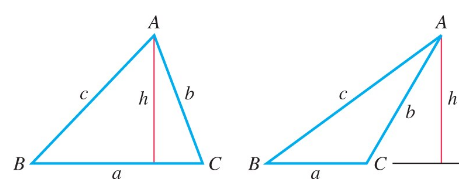
The law of sines The law of sines says that if a, b, and c are the sides opposite the angles A, B, and C in a triangle, then
(sin A) / a = (sin B) / b = (sin C) / c
Use the accompanying figures and the identity sin (π − θ) = sin θ, if required, to derive the law.
Problema 62
In Exercises 59–62, sketch the graph of the given function. What is the period of the function?
𝔂 = cos πx/2