Ch. 1 - Remembering General Chemistry: Electronic Structure and Bonding
Bruice - Organic Chemistry 8th Edition
Bruice8th EditionOrganic ChemistryISBN: 9780135213711Non è quello che usi tu?Cambia libro di testo
Capitolo 1, Problema 38(1)

a. Which bond would be longer?
b. Which bond would be stronger?
1. C—Cl or C—I

Guida verificata passo dopo passo
1
Step 1: Understand the relationship between bond length and atomic size. Bond length increases as the size of the bonded atoms increases. Iodine (I) is larger than chlorine (Cl) because it is further down the periodic table, so the C—I bond will be longer than the C—Cl bond.
Step 2: Recall the relationship between bond strength and bond length. Shorter bonds are generally stronger because the bonded atoms are closer together, leading to greater overlap of their atomic orbitals.
Step 3: Compare the bond strengths of C—Cl and C—I. Since the C—Cl bond is shorter than the C—I bond, it will also be stronger.
Step 4: Summarize the findings: The C—I bond is longer due to the larger size of iodine, and the C—Cl bond is stronger due to its shorter bond length.
Step 5: To reinforce understanding, consider periodic trends: As you move down a group in the periodic table, atomic size increases, leading to longer and weaker bonds when those atoms form covalent bonds.

Risposta video verificata per un problema simile:

Questa soluzione video è stata consigliata dai nostri tutor come utile per risolvere questo problema.
Durata del video:
3m

Concetti chiave

Ecco i concetti essenziali che devi comprendere per rispondere correttamente alla domanda.

Bond Length

Bond length refers to the distance between the nuclei of two bonded atoms. Generally, bond length increases with the size of the atoms involved; larger atoms have more electron shells, resulting in longer bonds. In the case of C—Cl and C—I, the iodine atom is larger than chlorine, leading to a longer C—I bond compared to the C—Cl bond.
Video consigliato:
06:00
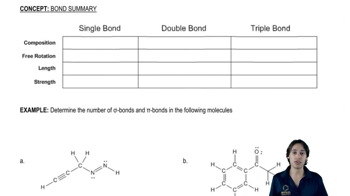
Single bonds, double bonds, and triple bonds.

Bond Strength

Bond strength, or bond dissociation energy, is a measure of how much energy is required to break a bond between two atoms. Stronger bonds have higher bond dissociation energies. In the comparison of C—Cl and C—I, the C—Cl bond is generally stronger due to the effective overlap of orbitals between the smaller chlorine atom and carbon, compared to the larger iodine atom.
Video consigliato:
06:00
Single bonds, double bonds, and triple bonds.

Electronegativity

Electronegativity is the tendency of an atom to attract electrons in a bond. It influences both bond length and strength. Chlorine is more electronegative than iodine, which contributes to the stronger C—Cl bond. The difference in electronegativity affects the bond character, with C—Cl being more polar and thus stronger than the less polar C—I bond.
Video consigliato:
1:47
Electronegativity