Ch. 1 - Remembering General Chemistry: Electronic Structure and Bonding
Bruice - Organic Chemistry 8th Edition
Bruice8th EditionOrganic ChemistryISBN: 9780135213711Non è quello che usi tu?Cambia libro di testo
Capitolo 1, Problema 41

Which of the bonds in a carbon–oxygen double bond has more effective orbital–orbital overlap: the σ bond or the π bond?

Guida verificata passo dopo passo
1
Understand the nature of the bonds in a carbon–oxygen double bond. A double bond consists of one sigma (σ) bond and one pi (π) bond. The σ bond is formed by the head-on overlap of orbitals, while the π bond is formed by the side-by-side overlap of p orbitals.
Recall that the effectiveness of orbital–orbital overlap depends on the geometry of the interaction. Head-on overlap in a σ bond allows for greater overlap compared to the side-by-side overlap in a π bond.
Consider the orbitals involved in the σ bond. In a carbon–oxygen double bond, the σ bond is typically formed by the overlap of a sp² hybrid orbital from carbon and a sp² hybrid orbital from oxygen. These hybrid orbitals are oriented directly along the bond axis, maximizing overlap.
Now consider the orbitals involved in the π bond. The π bond is formed by the unhybridized p orbitals on carbon and oxygen, which are perpendicular to the bond axis. The side-by-side overlap of these p orbitals is less effective compared to the head-on overlap in the σ bond.
Conclude that the σ bond in a carbon–oxygen double bond has more effective orbital–orbital overlap than the π bond due to the geometry and type of orbital interaction involved.

Risposta video verificata per un problema simile:

Questa soluzione video è stata consigliata dai nostri tutor come utile per risolvere questo problema.
Durata del video:
3m

Concetti chiave

Ecco i concetti essenziali che devi comprendere per rispondere correttamente alla domanda.

Sigma (σ) and Pi (π) Bonds

Sigma (σ) bonds are formed by the head-on overlap of atomic orbitals, allowing for a strong bond with cylindrical symmetry around the bond axis. In contrast, pi (π) bonds result from the side-to-side overlap of p orbitals, which is generally weaker due to less effective overlap. Understanding the differences in formation and strength between these bond types is crucial for analyzing double bonds.
Video consigliato:
01:05
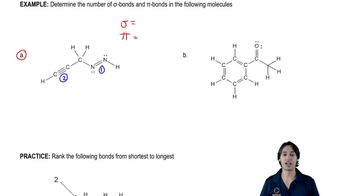
Sigma bonds and pi bonds

Orbital Overlap

Orbital overlap refers to the extent to which atomic orbitals from two atoms share space and interact when forming a bond. Greater overlap leads to stronger bonds. In a carbon-oxygen double bond, the σ bond has more effective overlap than the π bond, which is essential for understanding the stability and reactivity of such bonds in organic compounds.
Video consigliato:
08:41
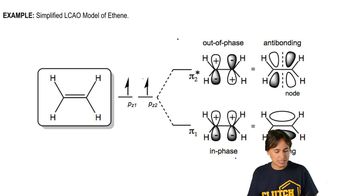
Review of Molecular Orbitals

Bond Strength and Stability

The strength and stability of a bond are influenced by the type of bonds present and their respective overlaps. Sigma bonds are generally stronger and more stable than pi bonds due to their effective overlap. In a carbon-oxygen double bond, the presence of both σ and π bonds means that while the σ bond provides significant stability, the π bond contributes to the overall reactivity of the molecule.
Video consigliato:
03:43
The radical stability trend.