Ch. 1 - Remembering General Chemistry: Electronic Structure and Bonding
Bruice - Organic Chemistry 8th Edition
Bruice8th EditionOrganic ChemistryISBN: 9780135213711Non è quello che usi tu?Cambia libro di testo
Capitolo 1, Problema 54a

Draw the ground-state electronic configuration for each of the following:
a. Mg

Guida verificata passo dopo passo
1
Step 1: Identify the atomic number of magnesium (Mg). Magnesium has an atomic number of 12, which means it has 12 electrons in its neutral state.
Step 2: Recall the order of electron filling based on the Aufbau principle. Electrons fill orbitals in the order of increasing energy levels: 1s, 2s, 2p, 3s, etc.
Step 3: Begin filling the orbitals with electrons. Start with the 1s orbital, which can hold a maximum of 2 electrons. Then proceed to the 2s orbital, which also holds 2 electrons.
Step 4: Next, fill the 2p orbital, which can hold a maximum of 6 electrons. After filling the 2p orbital, you will have placed 10 electrons. The remaining 2 electrons will go into the 3s orbital.
Step 5: Write the electronic configuration for magnesium. Using the format of subshell notation, the ground-state electronic configuration for Mg is: 1s22s22p63s2. This represents the distribution of electrons across the orbitals.

Risposta video verificata per un problema simile:

Questa soluzione video è stata consigliata dai nostri tutor come utile per risolvere questo problema.
Durata del video:
4m

Concetti chiave

Ecco i concetti essenziali che devi comprendere per rispondere correttamente alla domanda.

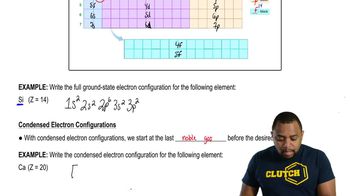
Electron Configuration

Electron configuration describes the distribution of electrons in an atom's orbitals. It follows the Aufbau principle, which states that electrons fill the lowest energy orbitals first, and is typically represented using a notation that indicates the number of electrons in each subshell (s, p, d, f). For example, magnesium (Mg) has an atomic number of 12, leading to an electron configuration of 1s² 2s² 2p⁶ 3s².
Video consigliato:
02:14
The Electron Configuration

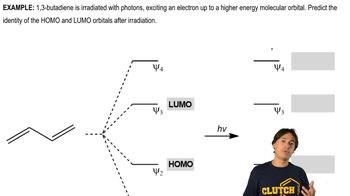
Ground State

The ground state of an atom refers to the lowest energy configuration of its electrons. In this state, electrons occupy the lowest available energy levels without any excitation. Understanding the ground state is crucial for predicting the chemical behavior of an element, as it determines how the atom will interact with others during chemical reactions.
Video consigliato:
03:08
Ground vs. Excited States

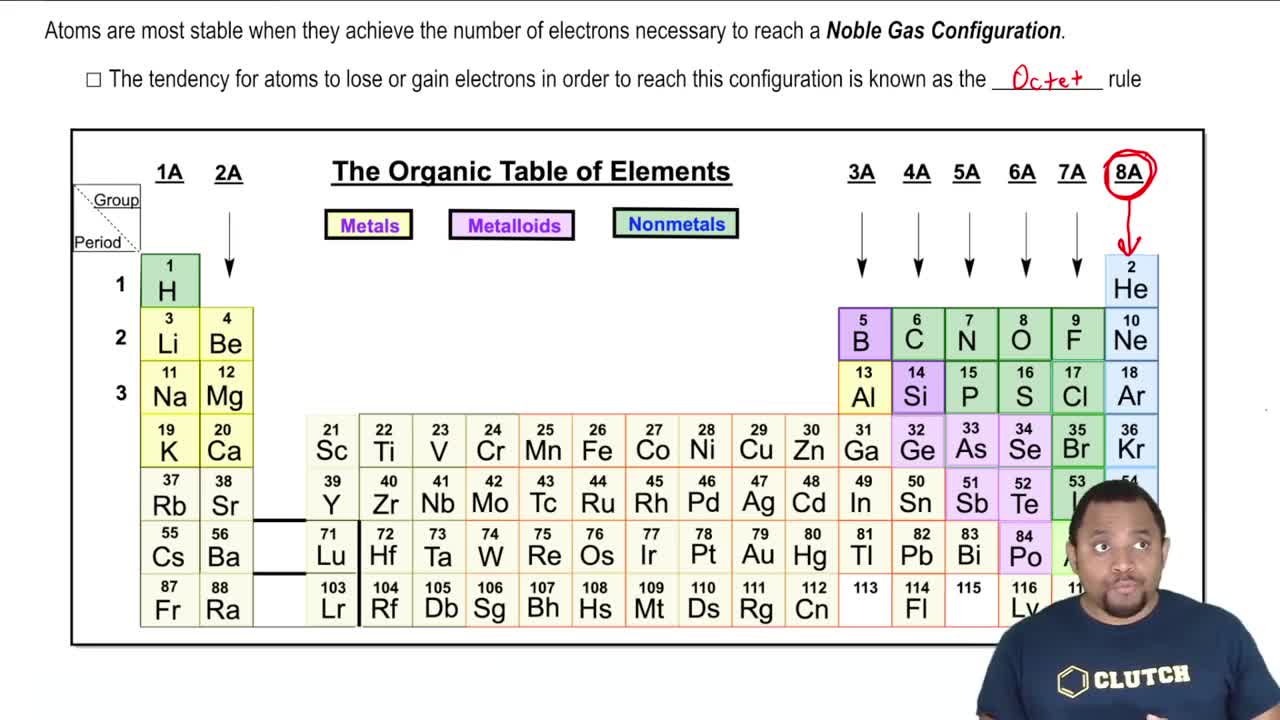
Periodic Table and Atomic Structure

The periodic table organizes elements based on their atomic number and electron configurations, revealing trends in chemical properties. Elements in the same group often exhibit similar behaviors due to their valence electron configurations. For magnesium, located in group 2, its two valence electrons in the 3s subshell play a significant role in its reactivity and bonding characteristics.
Video consigliato:
02:24
The most important parts of the periodic table for organic chemistry