Ch. 10 - Reactions of Alcohols, Ethers, Epoxides, Amines, and Sulfur-Containing Compounds
Bruice - Organic Chemistry 8th Edition
Bruice8th EditionOrganic ChemistryISBN: 9780135213711Non è quello che usi tu?Cambia libro di testo
Capitolo 10, Problema 35

Draw all possible resonance contributors for the two carbocations in the preceding reaction. Use the resonance contributors to explain why 1-naphthol is the major product of the reaction.

Guida verificata passo dopo passo
1
Identify the two carbocations formed in the reaction. These are intermediates that can delocalize their positive charge through resonance. Label them as carbocation A and carbocation B for clarity.
Draw the resonance structures for carbocation A. Start by identifying any π-electrons or lone pairs on adjacent atoms that can delocalize the positive charge. Use curved arrows to show the movement of electrons and draw all valid resonance contributors.
Repeat the process for carbocation B. Again, identify any π-electrons or lone pairs on adjacent atoms that can stabilize the positive charge through resonance. Use curved arrows to show electron movement and draw all valid resonance contributors.
Compare the resonance contributors of carbocation A and carbocation B. Evaluate the stability of each carbocation based on the number of resonance structures, the delocalization of the positive charge, and the involvement of aromatic systems (if applicable).
Explain why 1-naphthol is the major product. Use the stability of the carbocations and the resonance contributors to justify why the reaction proceeds through the pathway leading to 1-naphthol. Highlight the role of resonance stabilization in determining the major product.

Risposta video verificata per un problema simile:

Questa soluzione video è stata consigliata dai nostri tutor come utile per risolvere questo problema.
Durata del video:
5m

Concetti chiave

Ecco i concetti essenziali che devi comprendere per rispondere correttamente alla domanda.

Resonance Structures

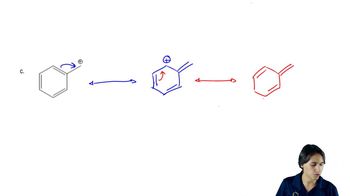
Resonance structures are different Lewis structures for the same molecule that depict the delocalization of electrons. They help illustrate how electrons are distributed across a molecule, particularly in systems with conjugated double bonds or lone pairs. The actual structure of the molecule is a hybrid of these resonance forms, which contributes to its stability and reactivity.
Video consigliato:
03:04
Drawing Resonance Structures

Carbocation Stability

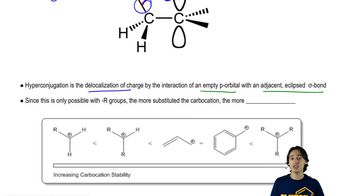
Carbocations are positively charged carbon species that can vary in stability based on their structure. Stability increases with the degree of substitution; tertiary carbocations are more stable than secondary or primary ones due to hyperconjugation and inductive effects. Understanding the stability of carbocations is crucial for predicting reaction pathways and product formation.
Video consigliato:
05:58
Determining Carbocation Stability

Nucleophilic Aromatic Substitution

Nucleophilic aromatic substitution is a reaction where a nucleophile replaces a leaving group on an aromatic ring. This process often involves the formation of a Meisenheimer complex, where the nucleophile adds to the ring, followed by the elimination of the leaving group. The presence of electron-withdrawing groups can enhance the reactivity of the aromatic compound, influencing the major product formed in the reaction.
Video consigliato:
01:47
Nucleophiles and Electrophiles can react in Substitution Reactions.