Ch. 10 - Reactions of Alcohols, Ethers, Epoxides, Amines, and Sulfur-Containing Compounds
Bruice - Organic Chemistry 8th Edition
Bruice8th EditionOrganic ChemistryISBN: 9780135213711Non è quello che usi tu?Cambia libro di testo
Capitolo 10, Problema 36b

The existence of the NIH shift was established by determining the major product obtained from rearrangement of the following arene oxide, in which a hydrogen has been replaced by a deuterium.
b. What would be the major product if the carbocation forms phenol by losing H+ or D+, rather than by going through the NIH shift?

Guida verificata passo dopo passo
1
Step 1: Analyze the structure of the arene oxide provided in the image. The molecule contains a benzene ring with an epoxide group attached, where one hydrogen is replaced by deuterium (D). Additionally, there is a methyl group (-CH3) attached to the benzene ring.
Step 2: Understand the reaction conditions. The presence of HB+ indicates acidic conditions, which can lead to the opening of the epoxide ring. This process typically involves protonation of the oxygen atom in the epoxide, making it more electrophilic and susceptible to nucleophilic attack.
Step 3: Consider the mechanism of ring opening. Protonation of the epoxide oxygen leads to the formation of a carbocation intermediate. The carbocation can undergo rearrangement via the NIH shift, where the deuterium (D) migrates to the adjacent carbon, or it can directly lose H+ or D+ to form phenol.
Step 4: If the carbocation loses H+ or D+ without undergoing the NIH shift, the major product will be phenol. The loss of H+ or D+ will result in the formation of a hydroxyl group (-OH) on the benzene ring at the position where the epoxide was originally attached.
Step 5: Predict the major product. If the carbocation loses H+, the phenol product will retain the deuterium (D) at its original position. If the carbocation loses D+, the phenol product will have hydrogen (H) at the position where deuterium was originally located. The major product depends on which proton (H+ or D+) is preferentially lost during the reaction.

Risposta video verificata per un problema simile:

Questa soluzione video è stata consigliata dai nostri tutor come utile per risolvere questo problema.
Durata del video:
12m

Concetti chiave

Ecco i concetti essenziali che devi comprendere per rispondere correttamente alla domanda.

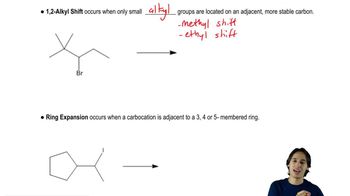
NIH Shift

The NIH shift refers to a specific rearrangement mechanism in organic chemistry where a hydrogen atom is replaced by a deuterium atom during the transformation of an arene oxide to a phenolic compound. This process involves the migration of a hydrogen atom to a neighboring carbon atom, resulting in a new carbocation intermediate. Understanding this shift is crucial for predicting the products of reactions involving arene oxides.
Video consigliato:
03:43
Alkyl Shift

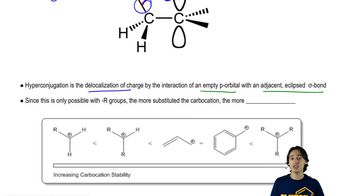
Carbocation Stability

Carbocation stability is a key concept in organic chemistry that describes the relative stability of positively charged carbon species. Factors influencing stability include the degree of substitution (primary, secondary, tertiary), resonance effects, and inductive effects from nearby atoms or groups. A more stable carbocation is more likely to form and dictate the pathway of the reaction, impacting the final product.
Video consigliato:
05:58
Determining Carbocation Stability

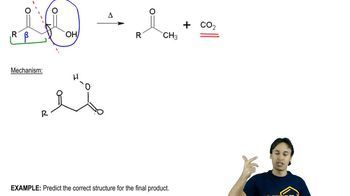
Deprotonation Mechanism

Deprotonation is the process of removing a proton (H+ or D+) from a molecule, which can lead to the formation of a stable product such as phenol. In the context of the question, understanding how a carbocation can lose a proton directly to form phenol, rather than undergoing a rearrangement like the NIH shift, is essential for predicting the major product of the reaction. This mechanism highlights the importance of reaction pathways in organic synthesis.
Video consigliato:
04:32
General Mechanism