Ch. 10 - Reactions of Alcohols, Ethers, Epoxides, Amines, and Sulfur-Containing Compounds
Bruice - Organic Chemistry 8th Edition
Bruice8th EditionOrganic ChemistryISBN: 9780135213711Non è quello che usi tu?Cambia libro di testo
Capitolo 10, Problema 39

Explain why the two arene oxides in [PROBLEM 10-38] open in opposite directions.

Guida verificata passo dopo passo
1
Step 1: Analyze the structures of the arene oxides in Reaction (i) and Reaction (ii). Both are epoxides derived from aromatic rings, but they differ in their substituents. In Reaction (i), the substituent is a positively charged nitrogen group, while in Reaction (ii), the substituent is an ethoxy group (-OCH2CH3).
Step 2: Understand the mechanism of epoxide ring opening. Epoxide rings are strained and prone to nucleophilic attack. The direction of ring opening depends on electronic and steric factors. In Reaction (i), the positively charged nitrogen group is electron-withdrawing, creating an electron-deficient site on the aromatic ring. In Reaction (ii), the ethoxy group is electron-donating, influencing the electron density differently.
Step 3: Consider the regioselectivity of the nucleophilic attack. In Reaction (i), the water molecule attacks the carbon adjacent to the positively charged nitrogen group because this position is more electrophilic due to the electron-withdrawing effect of the nitrogen group. In Reaction (ii), the water molecule attacks the carbon adjacent to the ethoxy group because the electron-donating nature of the ethoxy group stabilizes the positive charge formed during the ring opening.
Step 4: Examine steric effects. In Reaction (i), the bulky nitrogen group may also influence the direction of ring opening by sterically hindering attack on certain positions. In Reaction (ii), the ethoxy group is less bulky, allowing for a different regioselectivity in the attack.
Step 5: Summarize the reasoning. The two arene oxides open in opposite directions due to the electronic effects (electron-withdrawing vs. electron-donating) and steric effects of their substituents, which dictate the regioselectivity of the nucleophilic attack during the ring-opening process.

Risposta video verificata per un problema simile:

Questa soluzione video è stata consigliata dai nostri tutor come utile per risolvere questo problema.
Durata del video:
11m

Concetti chiave

Ecco i concetti essenziali che devi comprendere per rispondere correttamente alla domanda.

Arene Oxides

Arene oxides are reactive intermediates formed from the oxidation of aromatic compounds. They contain an epoxide structure, where an oxygen atom is incorporated into the aromatic ring, creating a three-membered cyclic ether. Their reactivity is significant in organic chemistry, particularly in electrophilic reactions, where they can undergo nucleophilic attack, leading to various products.
Video consigliato:
03:20
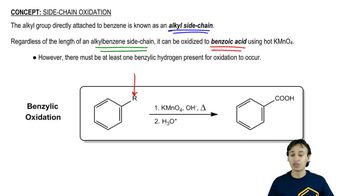
Benzylic Oxidation

Regioselectivity

Regioselectivity refers to the preference of a chemical reaction to occur at one location over another in a molecule. In the context of arene oxides, the direction in which the oxides open can be influenced by the electronic and steric effects of substituents on the aromatic ring. This concept is crucial for understanding why different arene oxides can yield products that differ in their structural orientation.
Video consigliato:
05:09
Heck Reaction

Nucleophilic Attack

Nucleophilic attack is a fundamental reaction mechanism in organic chemistry where a nucleophile donates an electron pair to an electrophile, forming a chemical bond. In the case of arene oxides, water acts as a nucleophile that attacks the electrophilic carbon in the epoxide, leading to the opening of the ring. The orientation of this attack can determine the final product's structure, explaining the observed differences in the reactions shown.
Video consigliato:
08:27
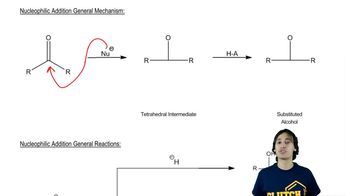
Nucleophilic Addition