Ch. 10 - Reactions of Alcohols, Ethers, Epoxides, Amines, and Sulfur-Containing Compounds
Bruice - Organic Chemistry 8th Edition
Bruice8th EditionOrganic ChemistryISBN: 9780135213711Non è quello che usi tu?Cambia libro di testo
Capitolo 10, Problema 56c

Indicate which alcohol in each pair undergoes an elimination reaction more rapidly when heated with H2SO4.
c.

Guida verificata passo dopo passo
1
Identify the structure of each alcohol in the pair. Look for the classification of each alcohol as primary, secondary, or tertiary based on the carbon atom to which the hydroxyl group (-OH) is attached.
Recall that the rate of elimination reactions, such as dehydration, generally increases with the degree of substitution of the alcohol. Tertiary alcohols typically undergo elimination more rapidly than secondary or primary alcohols.
Consider the mechanism of the elimination reaction. In the presence of a strong acid like H2SO4, alcohols undergo dehydration to form alkenes. This process often follows an E1 mechanism, especially for secondary and tertiary alcohols, where the formation of a stable carbocation intermediate is favored.
Evaluate the stability of the potential carbocation intermediates that would form from each alcohol. More substituted carbocations (tertiary > secondary > primary) are more stable and thus form more readily, leading to faster elimination reactions.
Compare the alcohols in the pair based on their structure and the stability of the carbocation intermediates they would form. The alcohol that forms the more stable carbocation will undergo the elimination reaction more rapidly when heated with H2SO4.

Risposta video verificata per un problema simile:

Questa soluzione video è stata consigliata dai nostri tutor come utile per risolvere questo problema.
Durata del video:
3m

Concetti chiave

Ecco i concetti essenziali che devi comprendere per rispondere correttamente alla domanda.

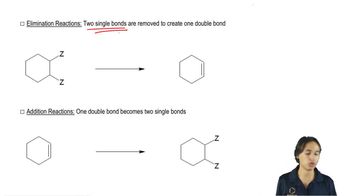
Elimination Reactions

Elimination reactions involve the removal of a small molecule from a larger one, typically resulting in the formation of a double bond. In organic chemistry, these reactions often occur with alcohols when treated with strong acids, leading to the formation of alkenes. The mechanism can follow either an E1 or E2 pathway, depending on the substrate and conditions.
Video consigliato:
00:40
Recognizing Elimination Reactions.

Alcohol Structure and Stability

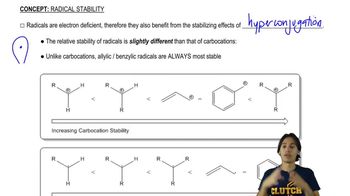
The structure of the alcohol, particularly the degree of substitution at the carbon bearing the hydroxyl group, significantly influences its reactivity in elimination reactions. Tertiary alcohols are generally more reactive than secondary or primary alcohols due to greater carbocation stability formed during the E1 mechanism, or better leaving group ability in E2 reactions.
Video consigliato:
03:43
The radical stability trend.

Role of H2SO4 in Dehydration

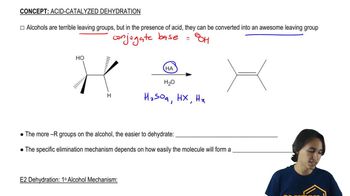
Sulfuric acid (H2SO4) acts as a strong acid and dehydrating agent in elimination reactions involving alcohols. It protonates the hydroxyl group, converting it into a better leaving group, and facilitates the removal of water. The heat applied during the reaction promotes the elimination process, favoring the formation of alkenes from the alcohols.
Video consigliato:
06:01
General features of acid-catalyzed dehydration.