Ch. 10 - Reactions of Alcohols, Ethers, Epoxides, Amines, and Sulfur-Containing Compounds
Bruice - Organic Chemistry 8th Edition
Bruice8th EditionOrganic ChemistryISBN: 9780135213711Non è quello che usi tu?Cambia libro di testo
Capitolo 10, Problema 57

Identify A–E.

Guida verificata passo dopo passo
1
Step 1: Analyze the first reaction. The starting compound is cyclohexene, which reacts with bromine (Br₂) in water (H₂O). This is a halohydrin formation reaction. Bromine adds across the double bond, and water provides the hydroxyl group (-OH). The product A is a bromohydrin, where one carbon of the double bond gets a bromine atom and the other gets a hydroxyl group.
Step 2: Identify B. In the halohydrin formation reaction, bromine reacts with water, and one of the byproducts is hydrobromic acid (HBr). Thus, B is HBr.
Step 3: Examine the second reaction. Compound A reacts with hydroxide ion (HO⁻). This is an elimination reaction where the hydroxide ion removes a proton, leading to the formation of an epoxide (C). The bromine atom is eliminated, and the oxygen from the hydroxyl group forms a three-membered ring with the two carbons.
Step 4: Analyze the third reaction. Compound C (the epoxide) reacts with hydroxide ion (HO⁻) in water (H₂O). This is a ring-opening reaction. The hydroxide ion attacks one of the carbons in the epoxide, breaking the ring and forming a diol (D). The two hydroxyl groups (-OH) are added to the carbons that were part of the epoxide ring.
Step 5: Identify E. In the ring-opening reaction, water is used as a solvent, but no additional byproducts are formed. Therefore, E is simply water (H₂O), which remains in the reaction mixture.

Risposta video verificata per un problema simile:

Questa soluzione video è stata consigliata dai nostri tutor come utile per risolvere questo problema.
Durata del video:
6m

Concetti chiave

Ecco i concetti essenziali che devi comprendere per rispondere correttamente alla domanda.

Functional Groups

Functional groups are specific groups of atoms within molecules that are responsible for the characteristic chemical reactions of those molecules. Understanding functional groups is essential in organic chemistry as they dictate the behavior and properties of organic compounds. Common examples include hydroxyl (-OH), carboxyl (-COOH), and amino (-NH2) groups.
Video consigliato:
02:36
Identifying Functional Groups

Nomenclature

Nomenclature in organic chemistry refers to the systematic naming of organic compounds based on their structure and functional groups. The International Union of Pure and Applied Chemistry (IUPAC) provides rules for naming compounds, which helps in identifying the structure and properties of the molecules. Mastery of nomenclature is crucial for effective communication and understanding in the field.
Video consigliato:
Percorso guidato
4:02
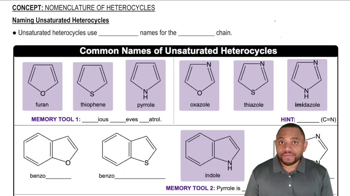
Nomenclature of Heterocycles Concept 2

Structural Isomerism

Structural isomerism occurs when compounds have the same molecular formula but different structural arrangements of atoms. This concept is vital in organic chemistry as isomers can exhibit vastly different physical and chemical properties. Understanding structural isomerism helps in predicting reactivity and interactions of organic compounds.
Video consigliato:
06:47
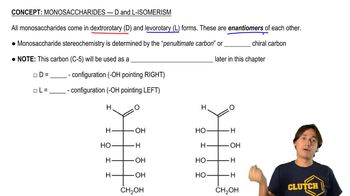
Monosaccharides - D and L Isomerism