Ch. 10 - Reactions of Alcohols, Ethers, Epoxides, Amines, and Sulfur-Containing Compounds
Bruice - Organic Chemistry 8th Edition
Bruice8th EditionOrganic ChemistryISBN: 9780135213711Non è quello che usi tu?Cambia libro di testo
Capitolo 10, Problema 25

Explain why methyl propyl ether forms both methyl iodide and propyl iodide when it is heated with excess HI.

Guida verificata passo dopo passo
1
When methyl propyl ether (CH₃OCH₂CH₂CH₃) is heated with excess HI, the reaction proceeds via an acid-catalyzed cleavage of the ether bond. The first step involves the protonation of the ether oxygen by HI, forming an oxonium ion (R-O⁺-R').
The oxonium ion is unstable and undergoes cleavage to form two products: a methyl group (CH₃⁺) and a propyl group (CH₂CH₂CH₃⁺). This cleavage occurs because ethers are susceptible to nucleophilic attack after protonation.
The iodide ion (I⁻) from HI acts as a nucleophile and attacks the carbocation formed during the cleavage. Depending on which bond breaks, either methyl iodide (CH₃I) or propyl iodide (CH₃CH₂CH₂I) is formed.
The cleavage of the ether bond is influenced by the stability of the carbocation intermediates. In this case, both methyl and propyl carbocations can form, but the reaction proceeds with both pathways due to the excess HI present.
As a result, both methyl iodide and propyl iodide are formed as products of the reaction, with the iodide ion reacting with each carbocation formed during the cleavage of the ether bond.

Risposta video verificata per un problema simile:

Questa soluzione video è stata consigliata dai nostri tutor come utile per risolvere questo problema.

Concetti chiave

Ecco i concetti essenziali che devi comprendere per rispondere correttamente alla domanda.

Ether Cleavage

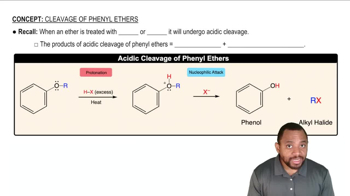
Ether cleavage is a reaction where ethers are broken down into their corresponding alcohols and alkyl halides in the presence of strong acids, such as HI. In this process, the ether bond (C-O) is cleaved, leading to the formation of two alkyl halides. This reaction is significant in organic chemistry as it demonstrates how ethers can be transformed into more reactive species.
Video consigliato:
Percorso guidato
1:45
Cleavage of Phenyl Ethers Concept 1

Nucleophilic Substitution

Nucleophilic substitution is a fundamental reaction mechanism in organic chemistry where a nucleophile replaces a leaving group in a molecule. In the case of methyl propyl ether reacting with HI, the iodide ion (I-) acts as a nucleophile, attacking the carbon atoms bonded to the ether oxygen, resulting in the formation of methyl iodide and propyl iodide. Understanding this mechanism is crucial for predicting the products of ether cleavage.
Video consigliato:
01:47
Nucleophiles and Electrophiles can react in Substitution Reactions.

Reactivity of Alkyl Halides

The reactivity of alkyl halides is influenced by the structure of the carbon atom to which the halide is attached. Methyl and primary alkyl halides, like those formed from methyl propyl ether, are generally more reactive towards nucleophiles due to less steric hindrance. This reactivity is essential in understanding why both methyl iodide and propyl iodide are produced when the ether is heated with excess HI.
Video consigliato:
01:52
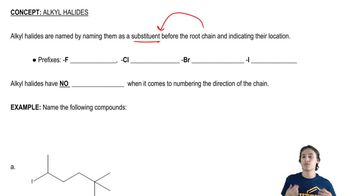
How to name alkyl halides