Ch. 10 - Reactions of Alcohols, Ethers, Epoxides, Amines, and Sulfur-Containing Compounds
Bruice - Organic Chemistry 8th Edition
Bruice8th EditionOrganic ChemistryISBN: 9780135213711Non è quello che usi tu?Cambia libro di testo
Capitolo 10, Problema 23

What are the major products obtained when the following ether is heated with one equivalent of HI?

Guida verificata passo dopo passo
1
Step 1: Analyze the structure of the ether provided. The ether consists of an oxygen atom bonded to two alkyl groups: ethyl (CH₃CH₂-) and isopropyl (CH₃CH(CH₃)-).
Step 2: Understand the reaction mechanism. When an ether is heated with one equivalent of HI, the bond between the oxygen and one of the alkyl groups is cleaved. The cleavage occurs via an SN2 mechanism if the alkyl group is primary or secondary, and via an SN1 mechanism if the alkyl group is tertiary.
Step 3: Determine which bond will break. In this case, the ethyl group is primary, and the isopropyl group is secondary. The bond between the oxygen and the ethyl group is more likely to break due to the SN2 mechanism being favored for primary alkyl groups.
Step 4: Predict the products. The cleavage of the ether will result in the formation of two products: ethyl iodide (CH₃CH₂I) and isopropanol (CH₃CH(CH₃)OH). The ethyl group reacts with the iodide ion (I⁻), while the isopropyl group retains the hydroxyl group (OH).
Step 5: Summarize the reaction. Heating the ether with one equivalent of HI results in the major products ethyl iodide and isopropanol, formed through the cleavage of the ether bond.

Risposta video verificata per un problema simile:

Questa soluzione video è stata consigliata dai nostri tutor come utile per risolvere questo problema.
Durata del video:
2m

Concetti chiave

Ecco i concetti essenziali che devi comprendere per rispondere correttamente alla domanda.

Ethers and Their Reactions

Ethers are organic compounds characterized by an oxygen atom connected to two alkyl or aryl groups. When heated with strong acids like HI, ethers undergo cleavage, breaking the C-O bond. This reaction typically results in the formation of alcohols and alkyl halides, depending on the structure of the ether and the conditions of the reaction.
Video consigliato:
04:22
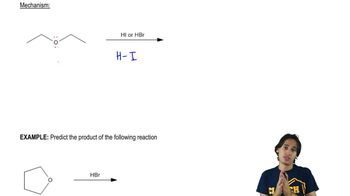
How to predict the products of Ether Cleavage.

Hydroiodic Acid (HI) as a Cleavage Agent

Hydroiodic acid is a strong acid that can protonate ethers, making them more susceptible to nucleophilic attack. In the presence of HI, the ether is cleaved to yield iodide ions and alcohols. The reactivity of HI facilitates the breaking of the ether bond, leading to the formation of the corresponding alkyl iodide and alcohol.
Video consigliato:
Percorso guidato
1:45
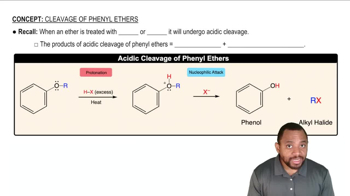
Cleavage of Phenyl Ethers Concept 1

Mechanism of Ether Cleavage

The mechanism of ether cleavage involves protonation of the ether oxygen, followed by nucleophilic attack by iodide ions. This results in the formation of an alkyl iodide and an alcohol. Understanding this mechanism is crucial for predicting the products of the reaction, as the structure of the ether influences the pathway and the major products formed.
Video consigliato:
Percorso guidato
1:57
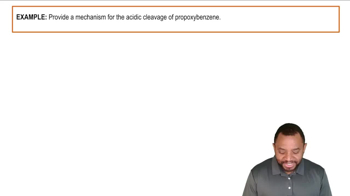
Cleavage of Phenyl Ethers Example 1