Ch. 10 - Reactions of Alcohols, Ethers, Epoxides, Amines, and Sulfur-Containing Compounds
Bruice - Organic Chemistry 8th Edition
Bruice8th EditionOrganic ChemistryISBN: 9780135213711Non è quello che usi tu?Cambia libro di testo
Capitolo 10, Problema 73a

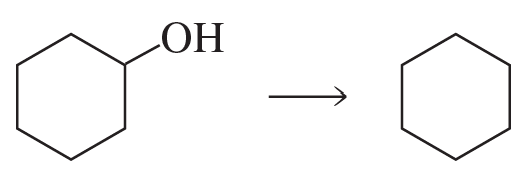
Using the given starting material, any necessary inorganic reagents, and any carbon-containing compounds with no more than two carbons, indicate how the following syntheses could be carried out:
a. Chemical reaction diagram showing the conversion of a cyclohexanol to cyclohexane with an arrow indicating the synthesis process.

Guida verificata passo dopo passo
1
Analyze the target molecule and the starting material to identify the functional groups present and the changes required to convert the starting material into the target molecule. This includes identifying any new bonds formed or broken, as well as any rearrangements or functional group transformations.
Determine the reagents and reactions needed to achieve the required transformations. For example, if a carbon-carbon bond needs to be formed, consider reactions like alkylation, aldol condensation, or Grignard reactions. If a functional group needs to be modified, consider oxidation, reduction, or substitution reactions.
Plan the synthesis step-by-step, ensuring that each intermediate is chemically feasible and that the reagents used are compatible with the functional groups present. For example, if the starting material contains a hydroxyl group, ensure that it is protected if necessary before proceeding with reactions that might affect it.
Verify that the carbon-containing compounds used in the synthesis have no more than two carbons, as per the problem's constraints. For example, you can use compounds like ethylene, acetylene, or formaldehyde as building blocks.
Write out the reaction sequence, including the starting material, intermediates, reagents, and conditions for each step. Ensure that the final product matches the target molecule in structure and stereochemistry.

Risposta video verificata per un problema simile:

Questa soluzione video è stata consigliata dai nostri tutor come utile per risolvere questo problema.
Durata del video:
2m

Concetti chiave

Ecco i concetti essenziali che devi comprendere per rispondere correttamente alla domanda.

Organic Synthesis

Organic synthesis is the process of constructing organic compounds through a series of chemical reactions. It involves the strategic selection of starting materials, reagents, and reaction conditions to achieve the desired product. Understanding the principles of organic synthesis is crucial for designing pathways that efficiently convert simple molecules into more complex structures.
Video consigliato:
Percorso guidato
1:16
Synthesis of Amino Acids: Strecker Synthesis Example 1

Reagents and Reaction Mechanisms

Reagents are substances used to bring about a chemical reaction, and understanding their roles is essential in organic chemistry. Different reagents can facilitate various types of reactions, such as nucleophilic substitutions or eliminations. Familiarity with reaction mechanisms helps predict the outcome of reactions and the conditions required for successful synthesis.
Video consigliato:
06:50
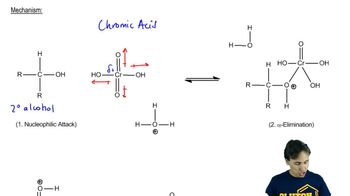
Jones Reagent Mechanism

Functional Groups

Functional groups are specific groups of atoms within molecules that are responsible for the characteristic chemical reactions of those molecules. Identifying functional groups is vital for predicting reactivity and guiding the synthesis process. Knowledge of how different functional groups interact allows chemists to manipulate and transform organic compounds effectively.
Video consigliato:
02:36
Identifying Functional Groups
Pratica correlata
Domanda del libro di testo

Using the given starting material, any necessary inorganic reagents, and any carbon-containing compounds with no more than two carbons, indicate how the following syntheses could be carried out:

b.

1034
views

Domanda del libro di testo

What product would be formed if the four-membered ring alcohol in Problem 70 were heated with an equivalent amount of HBr rather than with a catalytic amount of H2SO4?

907
views
Domanda del libro di testo

When 3-methyl-2-butanol is heated with concentrated HBr, a rearranged product is obtained. When 2-methyl-1-propanol reacts under the same conditions, a rearranged product is not obtained. Explain.

1557
views
Domanda del libro di testo

a. Draw the product or products that will be obtained from the reaction of cis-2-butene and trans-2-butene with each of the following reagents. If a product can exist as stereoisomers, show which stereoisomers are formed.

8. CH3OH + H2SO4

b. With which reagents do the two alkenes react to form different products?

647
views
Domanda del libro di testo

When piperidine undergoes the series of reactions shown here, 1,4-pentadiene is obtained as the product. When the four different methyl-substituted piperidines undergo the same series of reactions, each forms a different diene: 1,5-hexadiene; 1,4-pentadiene; 2-methyl-1,4-pentadiene; and 3-methyl-1,4-pentadiene. Which methyl-substituted piperidine forms which diene?

611
views
Domanda del libro di testo

Which of the following ethers would be obtained in greatest yield directly from alcohols?

736
views