Ch. 10 - Reactions of Alcohols, Ethers, Epoxides, Amines, and Sulfur-Containing Compounds
Bruice - Organic Chemistry 8th Edition
Bruice8th EditionOrganic ChemistryISBN: 9780135213711Non è quello che usi tu?Cambia libro di testo
Capitolo 10, Problema 75

When 3-methyl-2-butanol is heated with concentrated HBr, a rearranged product is obtained. When 2-methyl-1-propanol reacts under the same conditions, a rearranged product is not obtained. Explain.

Guida verificata passo dopo passo
1
Understand the reaction conditions: Heating an alcohol with concentrated HBr typically leads to the formation of an alkyl bromide via an SN1 or SN2 mechanism, depending on the structure of the alcohol. In this case, the possibility of carbocation rearrangement must be considered.
Analyze the structure of 3-methyl-2-butanol: This is a secondary alcohol. When it reacts with HBr, the hydroxyl group (-OH) is protonated to form water, a good leaving group. The departure of water generates a carbocation intermediate.
Examine the carbocation intermediate from 3-methyl-2-butanol: The initial carbocation formed is a secondary carbocation. Carbocations can rearrange to form a more stable carbocation. In this case, a hydride shift occurs, moving a hydrogen atom (along with its bonding electrons) from the adjacent carbon to the carbocation center, resulting in a tertiary carbocation, which is more stable. The bromide ion (Br⁻) then attacks this rearranged carbocation to form the final product.
Analyze the structure of 2-methyl-1-propanol: This is a primary alcohol. When it reacts with HBr, the hydroxyl group is protonated, and water leaves to form a primary carbocation. However, primary carbocations are highly unstable and do not form readily. Instead, the reaction proceeds via an SN2 mechanism, where the bromide ion directly displaces the leaving group without forming a carbocation intermediate. Since no carbocation is formed, no rearrangement occurs.
Summarize the difference: The key difference lies in the formation of a carbocation intermediate. 3-methyl-2-butanol forms a secondary carbocation that can rearrange to a more stable tertiary carbocation, leading to a rearranged product. In contrast, 2-methyl-1-propanol does not form a carbocation and reacts via an SN2 mechanism, preventing rearrangement.

Risposta video verificata per un problema simile:

Questa soluzione video è stata consigliata dai nostri tutor come utile per risolvere questo problema.
Durata del video:
6m

Concetti chiave

Ecco i concetti essenziali che devi comprendere per rispondere correttamente alla domanda.

Rearrangement in Organic Reactions

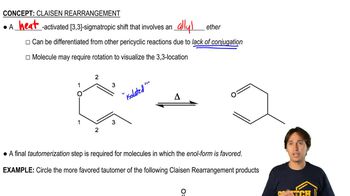
Rearrangement refers to the process where the structure of a molecule changes during a chemical reaction, often leading to more stable products. In organic chemistry, this can occur through carbocation intermediates, where the positive charge shifts to a more stable position, such as a tertiary carbon. This concept is crucial for understanding why certain alcohols can yield different products under similar reaction conditions.
Video consigliato:
06:08
Definition of Claisen Rearrangement

Carbocation Stability

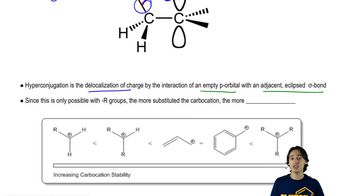
Carbocations are positively charged carbon species that can form during reactions involving alcohols and acids. Their stability is influenced by the degree of substitution: tertiary carbocations are more stable than secondary, which are more stable than primary. The stability of the carbocation formed from 3-methyl-2-butanol allows for rearrangement, while the less stable carbocation from 2-methyl-1-propanol does not favor rearrangement.
Video consigliato:
05:58
Determining Carbocation Stability

Mechanism of Alcohol Halogenation

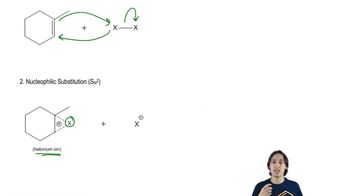
The mechanism of alcohol halogenation involves the protonation of the alcohol by a strong acid, leading to the formation of a carbocation. In the case of 3-methyl-2-butanol, the resulting carbocation can rearrange to a more stable form before reacting with bromide ions. In contrast, 2-methyl-1-propanol forms a less stable carbocation that does not undergo rearrangement, resulting in a different reaction pathway.
Video consigliato:
03:45
Halogenation Mechanism