Ch. 10 - Reactions of Alcohols, Ethers, Epoxides, Amines, and Sulfur-Containing Compounds
Bruice - Organic Chemistry 8th Edition
Bruice8th EditionOrganic ChemistryISBN: 9780135213711Non è quello che usi tu?Cambia libro di testo
Capitolo 10, Problema 21a,b

What alcohol would you treat with phosphorus oxychloride and pyridine to form each of the following alkenes?
a.
b.

Guida verificata passo dopo passo
1
Step 1: Recognize that the reaction involves converting an alcohol into an alkene using phosphorus oxychloride (POCl₃) and pyridine. This is an elimination reaction, specifically an E2 mechanism, where the hydroxyl group (-OH) is removed and a double bond is formed.
Step 2: For the first alkene (CH₃CH₂C=CH₂ with a methyl group attached to the second carbon), identify the alcohol precursor. The alcohol must have the hydroxyl group (-OH) attached to the carbon that will lose a hydrogen to form the double bond. The precursor alcohol is CH₃CH₂CH(OH)CH₃.
Step 3: For the second alkene (a cyclohexene with a methyl group attached to the double-bonded carbon), identify the alcohol precursor. The alcohol must have the hydroxyl group (-OH) attached to the carbon adjacent to the double bond. The precursor alcohol is 1-methylcyclohexanol.
Step 4: Understand the role of POCl₃ and pyridine in the reaction. POCl₃ acts as a dehydrating agent, facilitating the removal of the hydroxyl group and a hydrogen atom to form the double bond. Pyridine serves as a base to abstract the proton during the elimination step.
Step 5: Visualize the mechanism. In both cases, the hydroxyl group is converted into a good leaving group by POCl₃, and pyridine abstracts a proton from the β-carbon, leading to the formation of the double bond in the alkene product.

Risposta video verificata per un problema simile:

Questa soluzione video è stata consigliata dai nostri tutor come utile per risolvere questo problema.
Durata del video:
4m

Concetti chiave

Ecco i concetti essenziali che devi comprendere per rispondere correttamente alla domanda.

Dehydration of Alcohols

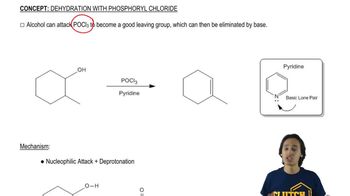
Dehydration of alcohols is a chemical reaction where water is removed from an alcohol to form an alkene. This process can be facilitated by various reagents, including strong acids or reagents like phosphorus oxychloride (POCl3). Understanding the mechanism of dehydration is crucial for predicting the formation of specific alkenes from given alcohols.
Video consigliato:
01:23
General Reaction of Dehydration with POCl3

Phosphorus Oxychloride (POCl3)

Phosphorus oxychloride is a reagent commonly used in organic synthesis to convert alcohols into alkyl chlorides or to facilitate dehydration reactions. It acts as a dehydrating agent, promoting the elimination of water from alcohols, which is essential for forming alkenes. Its use in conjunction with pyridine helps to neutralize the byproducts and stabilize the reaction environment.
Video consigliato:
01:23
General Reaction of Dehydration with POCl3

Regioselectivity in Elimination Reactions

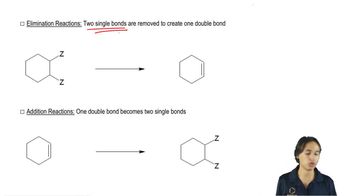
Regioselectivity refers to the preference of a chemical reaction to yield one structural isomer over others when multiple products are possible. In elimination reactions involving alcohols, the stability of the resulting alkene (based on factors like substitution and sterics) influences which alkene is formed. Understanding regioselectivity is key to predicting the products of dehydration reactions.
Video consigliato:
00:40
Recognizing Elimination Reactions.