Ch. 10 - Reactions of Alcohols, Ethers, Epoxides, Amines, and Sulfur-Containing Compounds
Bruice - Organic Chemistry 8th Edition
Bruice8th EditionOrganic ChemistryISBN: 9780135213711Non è quello che usi tu?Cambia libro di testo
Capitolo 10, Problema 62

What alkenes would you expect to be obtained from the acid-catalyzed dehydration of 1-hexanol?

Guida verificata passo dopo passo
1
Identify the starting material: 1-hexanol, which is an alcohol with the molecular formula C6H13OH.
Understand the reaction type: Acid-catalyzed dehydration of alcohols typically involves the removal of a water molecule to form an alkene.
Recognize the mechanism: The reaction proceeds via an E1 mechanism, where the alcohol is first protonated by the acid, leading to the formation of a carbocation intermediate.
Consider carbocation rearrangement: The initial carbocation can rearrange to form a more stable carbocation if possible, which can lead to different alkene products.
Determine possible alkenes: From the carbocation intermediate(s), identify the possible alkenes by considering the elimination of a proton from adjacent carbon atoms, leading to the formation of double bonds.

Risposta video verificata per un problema simile:

Questa soluzione video è stata consigliata dai nostri tutor come utile per risolvere questo problema.

Concetti chiave

Ecco i concetti essenziali che devi comprendere per rispondere correttamente alla domanda.

Dehydration Reaction

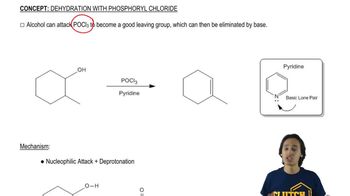
A dehydration reaction involves the removal of a water molecule from an alcohol, resulting in the formation of an alkene. In the case of 1-hexanol, this reaction is typically acid-catalyzed, meaning an acid is used to facilitate the removal of the hydroxyl group and a hydrogen atom from adjacent carbon atoms, leading to the formation of a double bond.
Video consigliato:
01:23
General Reaction of Dehydration with POCl3

Markovnikov's Rule

Markovnikov's Rule states that in the addition of HX to an alkene, the hydrogen atom will attach to the carbon with the greater number of hydrogen atoms already attached. This principle is crucial in predicting the major products of dehydration reactions, as it helps determine the stability of the resulting alkenes based on the carbocation intermediates formed during the reaction.
Video consigliato:
03:54
The 18 and 16 Electron Rule

Carbocation Stability

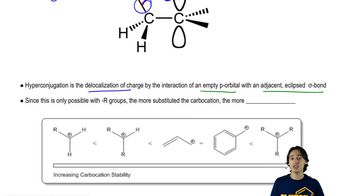
Carbocation stability is a key factor in organic reactions, particularly in dehydration processes. Carbocations are positively charged carbon species that can form during the dehydration of alcohols. The stability of these intermediates increases with the degree of substitution: tertiary carbocations are more stable than secondary, which are more stable than primary. This stability influences the major alkene products formed during the reaction.
Video consigliato:
05:58
Determining Carbocation Stability