Ch. 10 - Reactions of Alcohols, Ethers, Epoxides, Amines, and Sulfur-Containing Compounds
Bruice - Organic Chemistry 8th Edition
Bruice8th EditionOrganic ChemistryISBN: 9780135213711Non è quello che usi tu?Cambia libro di testo
Capitolo 10, Problema 61d

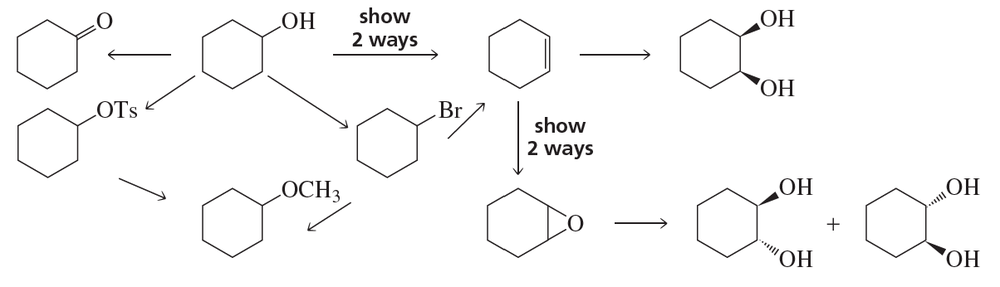
Write the appropriate reagent over each arrow.
Chemical reaction diagram illustrating various oxidizing agents with arrows indicating the appropriate reagents above each arrow.

Guida verificata passo dopo passo
1
Step 1: Analyze the first transformation (A). The starting material is a cyclohexyl bromide, and the product is cyclohexene. This suggests an elimination reaction. To achieve this, a strong base such as potassium tert-butoxide (K⁺[CH₃]₃CO⁻) or sodium ethoxide (NaOEt) can be used under heat to promote the E2 elimination mechanism.
Step 2: Understand the mechanism of the elimination reaction. The base abstracts a proton from the β-carbon (adjacent to the carbon bonded to bromine), leading to the formation of a double bond and the expulsion of the bromide ion.
Step 3: Analyze the second transformation (B). The product is a cyclohexane derivative with two hydroxyl groups in a cis configuration. This suggests a syn-dihydroxylation reaction of the alkene intermediate.
Step 4: To achieve syn-dihydroxylation, reagents such as osmium tetroxide (OsO₄) followed by a reducing agent like sodium bisulfite (NaHSO₃) or potassium permanganate (KMnO₄) under mild conditions can be used. These reagents add hydroxyl groups to the same face of the double bond.
Step 5: Verify stereochemistry. The cis-diol product indicates that the hydroxyl groups are added to the same side of the cyclohexene ring, consistent with the syn-dihydroxylation mechanism.

Risposta video verificata per un problema simile:

Questa soluzione video è stata consigliata dai nostri tutor come utile per risolvere questo problema.
Durata del video:
7m

Concetti chiave

Ecco i concetti essenziali che devi comprendere per rispondere correttamente alla domanda.

Retrosynthesis

Retrosynthesis is a strategy in organic chemistry used to deconstruct complex molecules into simpler precursors. This approach helps chemists identify the necessary reagents and reaction conditions needed to synthesize a target compound. By working backward from the desired product, chemists can plan a synthetic route that is efficient and feasible.
Video consigliato:
01:22
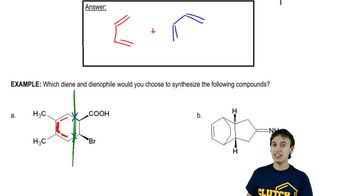
Retrosynthesis

Reagents in Organic Reactions

Reagents are substances that are added to a chemical reaction to cause a transformation. In organic chemistry, the choice of reagent can significantly influence the outcome of a reaction, including the formation of specific functional groups or the stereochemistry of the product. Understanding the role of different reagents is crucial for predicting reaction pathways and outcomes.
Video consigliato:
02:17
Identifying organic molecules

Functional Group Interconversion

Functional group interconversion refers to the process of transforming one functional group into another within a molecule. This concept is essential in organic synthesis, as it allows chemists to modify the reactivity and properties of compounds. Recognizing how to convert functional groups effectively is key to designing synthetic routes and achieving desired chemical transformations.
Video consigliato:
02:36
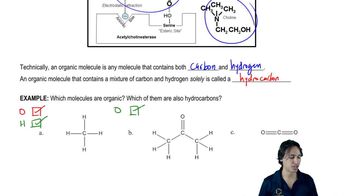
Identifying Functional Groups