Ch. 10 - Reactions of Alcohols, Ethers, Epoxides, Amines, and Sulfur-Containing Compounds
Bruice - Organic Chemistry 8th Edition
Bruice8th EditionOrganic ChemistryISBN: 9780135213711Non è quello che usi tu?Cambia libro di testo
Capitolo 10, Problema 59a

When heated with H2SO4, both 3,3-dimethyl-2-butanol and 2,3-dimethyl-2-butanol are dehydrated to form 2,3-dimethyl-2-butene. Which alcohol dehydrates more rapidly?

Guida verificata passo dopo passo
1
Identify the mechanism of dehydration: Dehydration of alcohols in the presence of H2SO4 typically follows an E1 (unimolecular elimination) mechanism for secondary and tertiary alcohols. This involves the formation of a carbocation intermediate.
Analyze the structure of 3,3-dimethyl-2-butanol: This alcohol is a tertiary alcohol because the carbon atom bonded to the hydroxyl (-OH) group is attached to three other carbon atoms. Tertiary alcohols generally form stable carbocations.
Analyze the structure of 2,3-dimethyl-2-butanol: This alcohol is also a tertiary alcohol, as the carbon atom bonded to the hydroxyl (-OH) group is attached to three other carbon atoms. However, the carbocation formed here is different due to the position of the substituents.
Compare the stability of the carbocations: The carbocation formed from 3,3-dimethyl-2-butanol is less stable because it lacks resonance or hyperconjugation effects. In contrast, the carbocation formed from 2,3-dimethyl-2-butanol is more stable due to hyperconjugation from the adjacent methyl groups, which can donate electron density to stabilize the positive charge.
Conclude which alcohol dehydrates more rapidly: Since the rate of dehydration in an E1 mechanism depends on the stability of the carbocation intermediate, 2,3-dimethyl-2-butanol will dehydrate more rapidly than 3,3-dimethyl-2-butanol.

Risposta video verificata per un problema simile:

Questa soluzione video è stata consigliata dai nostri tutor come utile per risolvere questo problema.
Durata del video:
9m

Concetti chiave

Ecco i concetti essenziali che devi comprendere per rispondere correttamente alla domanda.

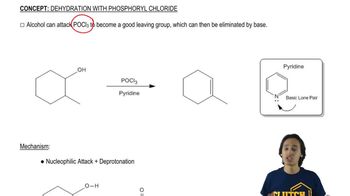
Dehydration Reaction

A dehydration reaction involves the removal of a water molecule from an alcohol, typically in the presence of an acid catalyst like H2SO4. This process leads to the formation of alkenes. The rate of dehydration can be influenced by the structure of the alcohol, including steric hindrance and the stability of the resulting carbocation.
Video consigliato:
01:23
General Reaction of Dehydration with POCl3

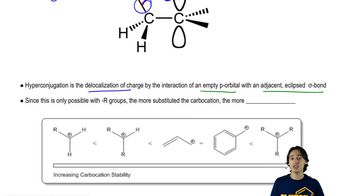
Carbocation Stability

Carbocation stability is a key factor in determining the rate of dehydration reactions. Tertiary carbocations are more stable than secondary or primary ones due to greater hyperconjugation and inductive effects from surrounding alkyl groups. The alcohol that forms a more stable carbocation during dehydration will generally dehydrate more rapidly.
Video consigliato:
05:58
Determining Carbocation Stability

Steric Hindrance

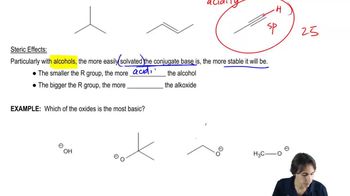
Steric hindrance refers to the prevention of chemical reactions due to the spatial arrangement of atoms within a molecule. In the context of alcohols, bulky groups around the hydroxyl-bearing carbon can hinder the approach of the acid catalyst and the formation of the carbocation, affecting the rate of dehydration. Understanding the steric effects in the given alcohols is crucial for predicting their reactivity.
Video consigliato:
02:53
Understanding steric effects.