Ch. 10 - Reactions of Alcohols, Ethers, Epoxides, Amines, and Sulfur-Containing Compounds
Bruice - Organic Chemistry 8th Edition
Bruice8th EditionOrganic ChemistryISBN: 9780135213711Non è quello che usi tu?Cambia libro di testo
Capitolo 10, Problema 58b

Starting with (R)-1-deuterio-1-propanol, how could you prepare
b. (S)-1-deuterio-1-methoxypropane?

Guida verificata passo dopo passo
1
Identify the starting material: (R)-1-deuterio-1-propanol. This compound has a hydroxyl (-OH) group attached to the first carbon, which is also chiral due to the presence of a deuterium (D) atom.
Plan the reaction sequence: To convert the hydroxyl group (-OH) into a methoxy group (-OCH₃), you need to perform a substitution reaction. However, the stereochemistry must also invert from (R) to (S), which suggests the use of an SN2 reaction mechanism.
Step 1: Convert the hydroxyl group (-OH) into a good leaving group. This can be achieved by reacting (R)-1-deuterio-1-propanol with a reagent like p-toluenesulfonyl chloride (TsCl) in the presence of a base (e.g., pyridine) to form the corresponding tosylate (R)-1-deuterio-1-propyl tosylate.
Step 2: Perform an SN2 reaction to replace the tosylate group with a methoxy group (-OCH₃). React the tosylate intermediate with sodium methoxide (NaOCH₃) in methanol. The SN2 mechanism will invert the stereochemistry, converting the (R)-configuration to the (S)-configuration.
Verify the product: The final product is (S)-1-deuterio-1-methoxypropane, which has the desired methoxy group and the correct (S)-stereochemistry at the chiral center.

Risposta video verificata per un problema simile:

Questa soluzione video è stata consigliata dai nostri tutor come utile per risolvere questo problema.
Durata del video:
6m

Concetti chiave

Ecco i concetti essenziali che devi comprendere per rispondere correttamente alla domanda.

Stereochemistry

Stereochemistry is the study of the spatial arrangement of atoms in molecules and how this affects their chemical behavior. In this question, understanding the difference between (R) and (S) configurations is crucial, as it involves the manipulation of chiral centers to achieve the desired stereoisomer. The Cahn-Ingold-Prelog priority rules are typically used to assign these configurations.
Video consigliato:
Percorso guidato
1:38
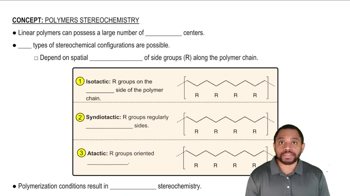
Polymer Stereochemistry Concept 1

Nucleophilic Substitution Reactions

Nucleophilic substitution reactions are fundamental organic reactions where a nucleophile replaces a leaving group in a molecule. In the context of preparing (S)-1-deuterio-1-methoxypropane from (R)-1-deuterio-1-propanol, a nucleophilic substitution can be employed, typically involving the conversion of the alcohol to a better leaving group followed by reaction with a methoxide ion.
Video consigliato:
01:47
Nucleophiles and Electrophiles can react in Substitution Reactions.

Deuteration

Deuteration refers to the substitution of hydrogen atoms in a molecule with deuterium, an isotope of hydrogen. This process is significant in the question as it involves maintaining the deuterium label while transforming (R)-1-deuterio-1-propanol into (S)-1-deuterio-1-methoxypropane. Understanding how deuterium affects molecular properties and reactivity is essential for predicting the outcome of the reaction.