Ch. 10 - Reactions of Alcohols, Ethers, Epoxides, Amines, and Sulfur-Containing Compounds
Bruice - Organic Chemistry 8th Edition
Bruice8th EditionOrganic ChemistryISBN: 9780135213711Non è quello che usi tu?Cambia libro di testo
Capitolo 10, Problema 61c

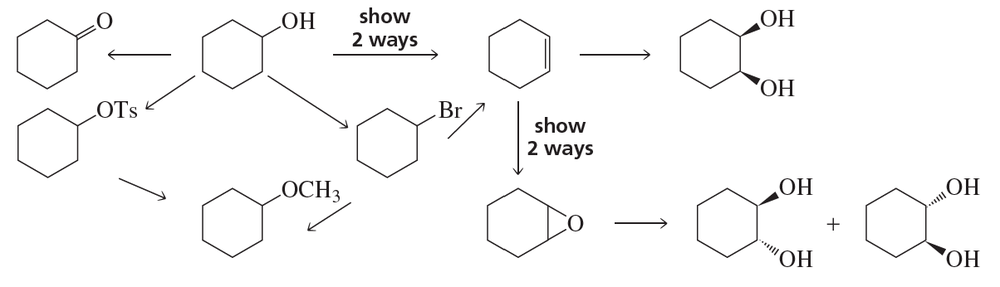
Write the appropriate reagent over each arrow.
Chemical reaction diagram illustrating various oxidizing agents with arrows indicating the appropriate reagents above each arrow.

Guida verificata passo dopo passo
1
Step 1: Analyze the starting material, which is cyclopentanol. The hydroxyl (-OH) group is attached to a cyclopentane ring.
Step 2: Identify the product, which is cyclopentene. This indicates that the reaction involves the elimination of water (dehydration) to form a double bond.
Step 3: Recognize that the appropriate reagent for this transformation is typically an acid catalyst, such as H₂SO₄ (sulfuric acid) or H₃PO₄ (phosphoric acid), to promote dehydration.
Step 4: Note that heat is often required to drive the elimination reaction, as it helps overcome the activation energy for the formation of the alkene.
Step 5: Write the reagents over the arrow: 'A' could be H₂SO₄ or H₃PO₄, and 'B' could be heat, indicating the conditions necessary for the reaction.

Risposta video verificata per un problema simile:

Questa soluzione video è stata consigliata dai nostri tutor come utile per risolvere questo problema.
Durata del video:
8m

Concetti chiave

Ecco i concetti essenziali che devi comprendere per rispondere correttamente alla domanda.

Dehydration Reaction

A dehydration reaction involves the removal of a water molecule from a compound, typically resulting in the formation of a double bond. In organic chemistry, this process is common when converting alcohols into alkenes. The reaction often requires heat and an acid catalyst to facilitate the elimination of water.
Video consigliato:
01:23
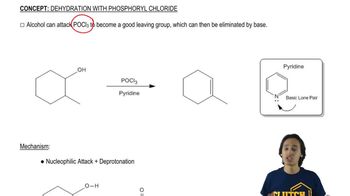
General Reaction of Dehydration with POCl3

Reagents in Organic Reactions

Reagents are substances that are added to a chemical reaction to cause a change or facilitate a reaction. In the context of dehydration of alcohols, common reagents include strong acids like sulfuric acid or phosphoric acid, which help protonate the alcohol and promote the elimination of water.
Video consigliato:
02:17
Identifying organic molecules

Mechanism of Elimination Reactions

Elimination reactions, such as dehydration, typically follow a two-step mechanism: protonation of the alcohol followed by the loss of water to form a carbocation intermediate. This intermediate can then lose a proton to form a double bond, resulting in the final alkene product. Understanding this mechanism is crucial for predicting the outcome of the reaction.
Video consigliato:
00:40
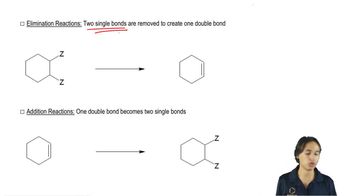
Recognizing Elimination Reactions.