

A student added an equivalent of 3,4-epoxy-4-methylcyclohexanol to a solution of methylmagnesium bromide in diethyl ether, and then added dilute hydrochloric acid. He expected that the product would be 1,2-dimethyl-1,4-cyclohexanediol. He did not get any of the expected product. What product did he get?
Ch. 11 - Organometallic Compounds
Capitolo 11, Problema 38b
Using the given starting material, any necessary inorganic reagents and catalysts, and any carbon-containing compounds with no more than two carbons, indicate how each of the following compounds can be prepared:
b. 
Guida verificata passo dopo passo1
Step 1: Analyze the starting material (CH₃CH=CHCH₃) and the target product (CH₃CH=CCH₂CH₃ with a methyl group attached to the double bond). Notice that the transformation involves the addition of a methyl group to the double bond.
Step 2: Identify the type of reaction required. This is an alkylation reaction where a methyl group is added to the double bond. A common method to achieve this is through the use of carbocation intermediates.
Step 3: Select appropriate reagents. To add a methyl group, you can use a methyl halide (e.g., CH₃Br or CH₃Cl) in the presence of a strong acid catalyst such as H₂SO₄ or AlCl₃ to generate the carbocation intermediate.
Step 4: Mechanism of the reaction: The double bond in the starting material will act as a nucleophile and attack the carbocation generated from the methyl halide. This leads to the formation of the desired product with the methyl group added to the double bond.
Step 5: Ensure the reaction conditions are controlled to avoid side reactions. Use mild temperatures and monitor the reaction to ensure selective addition of the methyl group to the correct position on the double bond.

Risposta video verificata per un problema simile:
Questa soluzione video è stata consigliata dai nostri tutor come utile per risolvere questo problema.
Durata del video:
6mConcetti chiave
Ecco i concetti essenziali che devi comprendere per rispondere correttamente alla domanda.
Organic Synthesis
Organic synthesis is the process of constructing organic compounds through chemical reactions. It involves the strategic selection of starting materials, reagents, and conditions to achieve the desired product. Understanding the principles of organic synthesis is crucial for designing pathways to synthesize specific compounds, especially when limited to certain reagents and carbon sources.
Video consigliato:
Percorso guidato
Synthesis of Amino Acids: Strecker Synthesis Example 1
Reagents and Catalysts
Reagents are substances used in chemical reactions to bring about a transformation, while catalysts are substances that increase the rate of a reaction without being consumed. In organic synthesis, the choice of reagents and catalysts can significantly influence the efficiency and selectivity of the reaction. Familiarity with common inorganic reagents and catalysts is essential for planning synthetic routes.
Video consigliato:
Percorso guidato
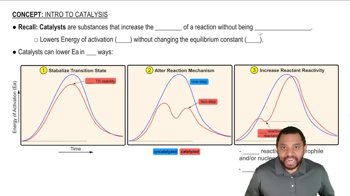
Introduction to Catalysis Concept 1
Functional Groups
Functional groups are specific groups of atoms within molecules that are responsible for the characteristic chemical reactions of those molecules. Recognizing functional groups is vital in organic chemistry, as they dictate the reactivity and properties of compounds. Understanding how to manipulate these groups during synthesis is key to preparing the desired products from given starting materials.
Video consigliato:
Identifying Functional Groups
Pratica correlata
Domanda del libro di testo
1050
views
Domanda del libro di testo
What are the products of the following reactions?
d.
1144
views
Domanda del libro di testo
Using the given starting material, any necessary inorganic reagents and catalysts, and any carbon-containing compounds with no more than two carbons, indicate how each of the following compounds can be prepared:
a.
1086
views
Domanda del libro di testo
Using the given starting material, any necessary inorganic reagents and catalysts, and any carbon-containing compounds with no more than two carbons, indicate how each of the following compounds can be prepared:
c.
1080
views
Domanda del libro di testo
Dimerization is a side reaction that occurs during the preparation of a Grignard reagent. Propose a mechanism that accounts for the formation of the dimer.
1281
views
Domanda del libro di testo
What are the products of the following reactions?
b.
1034
views
