Ch. 11 - Organometallic Compounds
Bruice - Organic Chemistry 8th Edition
Bruice8th EditionOrganic ChemistryISBN: 9780135213711Non è quello che usi tu?Cambia libro di testo
Capitolo 11, Problema 28

Which of the following alkyl halides could be successfully used to form a Grignard reagent?

Guida verificata passo dopo passo
1
Identify the general structure of a Grignard reagent. A Grignard reagent is an organomagnesium compound with the formula \( \text{R-MgX} \), where \( \text{R} \) is an alkyl or aryl group and \( \text{X} \) is a halogen (Cl, Br, or I).
Understand the conditions required for the formation of a Grignard reagent. The alkyl halide must not contain functional groups that are reactive with the Grignard reagent itself, such as \( \text{-OH} \), \( \text{-NH_2} \), \( \text{-COOH} \), or \( \text{-C=O} \), as these groups can react with the highly nucleophilic \( \text{R-MgX} \).
Evaluate the alkyl halides provided in the problem. Check if the halogen is attached to a carbon atom that is not sterically hindered or part of a highly reactive functional group. Primary and secondary alkyl halides are generally suitable, while tertiary alkyl halides may not work well due to steric hindrance.
Ensure that the halogen in the alkyl halide is suitable for Grignard reagent formation. Chlorine (Cl), bromine (Br), and iodine (I) are commonly used, while fluorine (F) is generally not reactive enough to form a Grignard reagent.
Exclude any alkyl halides that contain incompatible functional groups or structural features, and identify the ones that meet all the criteria for successful Grignard reagent formation.

Risposta video verificata per un problema simile:

Questa soluzione video è stata consigliata dai nostri tutor come utile per risolvere questo problema.
Durata del video:
3m

Concetti chiave

Ecco i concetti essenziali che devi comprendere per rispondere correttamente alla domanda.

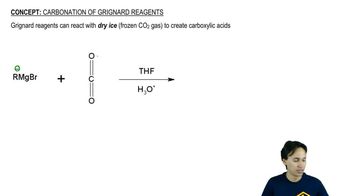
Grignard Reagents

Grignard reagents are organomagnesium compounds formed by the reaction of alkyl or aryl halides with magnesium metal in dry ether. They are highly reactive nucleophiles used in organic synthesis to form carbon-carbon bonds. The general formula for a Grignard reagent is R-MgX, where R is an alkyl or aryl group and X is a halogen.
Video consigliato:
02:12
Carbonation of Grignard Reagents

Alkyl Halides

Alkyl halides are organic compounds containing a carbon chain bonded to a halogen atom (F, Cl, Br, or I). The reactivity of alkyl halides in forming Grignard reagents depends on the type of halide and the stability of the resulting reagent. Primary alkyl halides are generally preferred for Grignard formation, while tertiary halides often lead to elimination reactions instead.
Video consigliato:
01:52
How to name alkyl halides

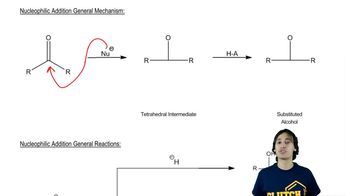
Nucleophilicity and Reactivity

Nucleophilicity refers to the ability of a species to donate an electron pair to an electrophile, which is crucial in the formation of Grignard reagents. The reactivity of alkyl halides in this context is influenced by steric hindrance and the leaving group ability of the halide. Stronger nucleophiles and better leaving groups facilitate the formation of Grignard reagents, making the choice of alkyl halide critical.
Video consigliato:
08:27
Nucleophilic Addition