Ch. 12 - Radicals
Bruice - Organic Chemistry 8th Edition
Bruice8th EditionOrganic ChemistryISBN: 9780135213711Non è quello che usi tu?Cambia libro di testo
Capitolo 12, Problema 4f

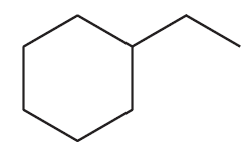
How many alkyl chlorides are obtained from monochlorination of the following alkanes? Disregard stereoisomers.
f. Chemical structure of a cyclohexane with a side chain, illustrating alkyl chloride formation from monochlorination.

Guida verificata passo dopo passo
1
Step 1: Analyze the structure of the given alkane. The molecule is a cyclopentane ring with a single ethyl group attached to one of the carbons in the ring.
Step 2: Identify all unique types of hydrogen atoms in the molecule. Hydrogens attached to different types of carbons (primary, secondary, tertiary) will lead to different alkyl chlorides upon monochlorination.
Step 3: Determine the types of carbons in the molecule. The cyclopentane ring has secondary carbons, and the ethyl group has primary carbons. Each type of carbon will yield a unique alkyl chloride upon chlorination.
Step 4: Count the unique positions for chlorination. In the cyclopentane ring, all secondary carbons are equivalent due to symmetry, leading to one type of alkyl chloride. The primary carbons in the ethyl group are also equivalent, leading to another type of alkyl chloride.
Step 5: Conclude that the total number of alkyl chlorides obtained from monochlorination is the sum of the unique chlorination positions identified in the previous steps.

Risposta video verificata per un problema simile:

Questa soluzione video è stata consigliata dai nostri tutor come utile per risolvere questo problema.
Durata del video:
1m

Concetti chiave

Ecco i concetti essenziali che devi comprendere per rispondere correttamente alla domanda.

Monochlorination

Monochlorination is a chemical reaction where one chlorine atom replaces a hydrogen atom in an alkane. This process typically occurs through a free radical mechanism, which involves the generation of chlorine radicals that abstract hydrogen atoms from the alkane, leading to the formation of alkyl chlorides. Understanding this process is crucial for predicting the products of chlorination reactions.
Video consigliato:
04:37
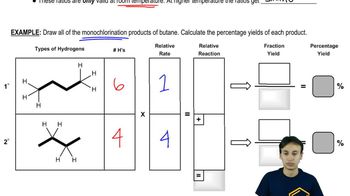
Draw all of the monochlorination products and calculate percentage yields.

Alkyl Chlorides

Alkyl chlorides, also known as haloalkanes, are organic compounds derived from alkanes by replacing one or more hydrogen atoms with chlorine atoms. The structure and branching of the original alkane influence the number and types of alkyl chlorides formed during monochlorination. Recognizing the different possible products is essential for solving the question regarding the number of alkyl chlorides produced.
Video consigliato:
03:13
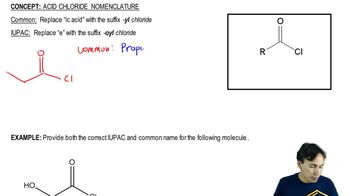
Acid Chloride Nomenclature

Stereoisomers

Stereoisomers are compounds that have the same molecular formula and connectivity of atoms but differ in the spatial arrangement of their atoms. In the context of monochlorination, disregarding stereoisomers means that only unique structural isomers of alkyl chlorides are considered, simplifying the analysis of the products. This concept is important for accurately counting the distinct alkyl chlorides formed from the reaction.
Video consigliato:
01:58
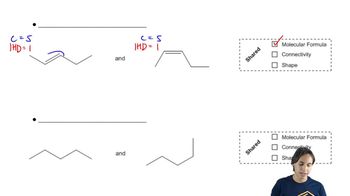
Determining when molecules are stereoisomers.