Ch. 12 - Radicals
Bruice - Organic Chemistry 8th Edition
Bruice8th EditionOrganic ChemistryISBN: 9780135213711Non è quello che usi tu?Cambia libro di testo
Capitolo 12, Problema 5

If cyclopentane reacts with more than one equivalent of Cl2 at a high temperature, how many dichlorocyclopentanes would you expect to obtain as products?

Guida verificata passo dopo passo
1
Analyze the structure of cyclopentane: Cyclopentane is a cyclic alkane with the molecular formula C5H10. It consists of a five-membered ring where all carbon atoms are sp3 hybridized, and all hydrogens are equivalent due to the symmetry of the molecule.
Understand the reaction conditions: The reaction involves Cl2 and high temperature, which suggests a free radical halogenation mechanism. In this mechanism, chlorine radicals will abstract hydrogens from the cyclopentane ring, leading to the formation of chlorinated products.
Determine the possible positions for chlorination: Since all hydrogens in cyclopentane are equivalent, the first chlorination will produce only one monochlorocyclopentane product. For the second chlorination, the chlorine can attach to any of the remaining hydrogens, leading to different dichlorocyclopentane isomers.
Consider the symmetry of the molecule: Due to the symmetry of cyclopentane, some dichlorocyclopentane products will be identical. For example, if the two chlorines are attached to adjacent carbons, the product will be the same regardless of which adjacent carbons are chosen. Similarly, if the chlorines are attached to carbons that are not adjacent, the symmetry of the ring will reduce the number of unique products.
Count the unique dichlorocyclopentane isomers: Based on the positions of the chlorines (e.g., on the same carbon, on adjacent carbons, or on carbons separated by one or more carbons), determine the total number of unique dichlorocyclopentane products. This requires considering both the relative positions of the chlorines and the symmetry of the molecule.

Risposta video verificata per un problema simile:

Questa soluzione video è stata consigliata dai nostri tutor come utile per risolvere questo problema.
Durata del video:
5m

Concetti chiave

Ecco i concetti essenziali che devi comprendere per rispondere correttamente alla domanda.

Free Radical Halogenation

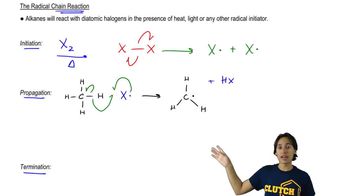
Free radical halogenation is a reaction mechanism where alkanes react with halogens (like Cl<sub>2</sub>) under heat or light to form alkyl halides. This process involves the formation of free radicals, which are highly reactive species that can lead to multiple substitution reactions. Understanding this mechanism is crucial for predicting the products formed when cyclopentane reacts with chlorine.
Video consigliato:
12:11
Radical Chain Reaction Mechanism.

Substitution Patterns

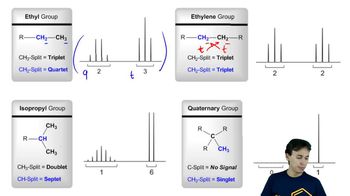
In the context of cyclopentane, substitution patterns refer to the different positions on the cyclopentane ring where chlorine atoms can be added. Due to the symmetrical nature of cyclopentane, multiple isomers can form depending on whether the chlorine atoms are added to the same carbon or different carbons. Recognizing these patterns helps in determining the number of distinct dichlorocyclopentane products.
Video consigliato:
08:06
Common Splitting Patterns

Isomerism

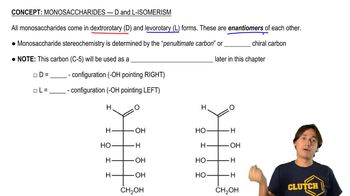
Isomerism is the phenomenon where compounds with the same molecular formula can have different structural arrangements. In the case of dichlorocyclopentanes, the presence of two chlorine atoms can lead to various isomers, including positional isomers and stereoisomers. Understanding isomerism is essential for accurately predicting and counting the different products formed in the reaction.
Video consigliato:
06:47
Monosaccharides - D and L Isomerism