Ch. 12 - Radicals
Bruice - Organic Chemistry 8th Edition
Bruice8th EditionOrganic ChemistryISBN: 9780135213711Non è quello che usi tu?Cambia libro di testo
Capitolo 12, Problema 43a

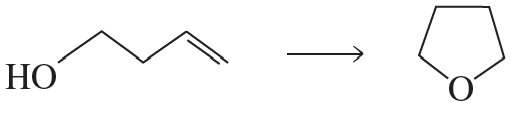
Using the given starting material and any necessary organic or inorganic reagents, indicate how the desired compounds could be synthesized:
a. Synthesis pathway showing a hydroxyl group transforming into a cyclic ether structure.

Guida verificata passo dopo passo
1
Step 1: Analyze the starting material and the target compound. The starting material is a 5-carbon alcohol with a terminal alkene, and the target compound is a cyclic ether (tetrahydropyran). This suggests an intramolecular reaction to form a ring.
Step 2: Protonate the hydroxyl group using an acid catalyst, such as H2SO4 or HCl, to convert it into a good leaving group (water). This step activates the alcohol for further reaction.
Step 3: The protonated alcohol can undergo an intramolecular nucleophilic attack by the alkene. The alkene acts as a nucleophile, attacking the carbocation formed after the alcohol leaves, leading to ring closure.
Step 4: Ensure the reaction conditions favor cyclization. Use mild heating to promote the intramolecular reaction and avoid side reactions such as polymerization of the alkene.
Step 5: Neutralize the reaction mixture and isolate the cyclic ether product (tetrahydropyran) using purification techniques such as distillation or chromatography.

Risposta video verificata per un problema simile:

Questa soluzione video è stata consigliata dai nostri tutor come utile per risolvere questo problema.
Durata del video:
6m

Concetti chiave

Ecco i concetti essenziali che devi comprendere per rispondere correttamente alla domanda.

Radical Reactions

Radical reactions involve the formation and reaction of radicals, which are species with unpaired electrons. These reactions are typically initiated by heat or light, leading to the generation of radicals that can react with other molecules. Understanding the mechanisms of radical formation and termination is crucial for predicting the outcomes of these reactions, especially in the synthesis of cyclic ethers from linear alcohols.
Video consigliato:
03:49
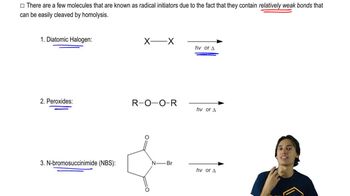
What are Radical Initiators?

Cyclic Ether Formation

Cyclic ethers are formed when a linear chain of atoms undergoes a reaction that creates a ring structure, often through intramolecular reactions. In the context of the provided synthesis pathway, the conversion of an alcohol to a cyclic ether typically involves the formation of a radical intermediate that facilitates the closure of the ring. Recognizing the conditions and reagents that favor this transformation is essential for successful synthesis.
Video consigliato:
06:23
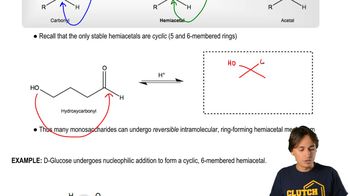
Monosaccharides - Forming Cyclic Hemiacetals

Reagents and Conditions

The choice of reagents and reaction conditions is critical in organic synthesis. For the transformation from an alcohol to a cyclic ether, specific reagents such as radical initiators or catalysts may be required to promote the reaction. Additionally, controlling factors like temperature and solvent can influence the reaction pathway and yield, making it important to understand how these variables affect radical chemistry and cyclic ether formation.
Video consigliato:
01:52
Reagents
Pratica correlata
Domanda del libro di testo

At 600 °C, the ratio of the relative rates of formation of a tertiary, a secondary, and a primary radical by a chlorine radical is 2.6 : 2.1 : 1. Explain the change in the degree of regioselectivity compared to what was found in Problem 44.

983
views
Domanda del libro di testo

Starting with cyclohexane, how could the following compounds be prepared?

e.

1403
views
Domanda del libro di testo

Given that ∆H° for the reaction is -42 kcal/mol and the bond dissociation enthalpies for the C−H, C−Cl, and O−H bonds are 101, 85, and 105 kcal/mol respectively, calculate the bond dissociation enthalpy of the O−Cl bond.

1243
views
Domanda del libro di testo

Using the given starting material and any necessary organic or inorganic reagents, indicate how the desired compounds could be synthesized:

c.

1205
views
Domanda del libro di testo

A chemist wanted to determine experimentally the relative ease of removing a hydrogen atom from a tertiary, a secondary, and a primary carbon by a chlorine radical. He allowed 2-methylbutane to undergo chlorination at 300 °C and obtained as products 36% 1-chloro-2-methylbutane, 18% 2-chloro-2-methylbutane, 28% 2-chloro-3-methylbutane, and 18% 1-chloro-3-methylbutane. What values did he obtain for the relative ease of removing a hydrogen atom from tertiary, secondary, and primary hydrogen carbons by a chlorine radical under the conditions of his experiment?

1323
views
Domanda del libro di testo

Propose a mechanism for the following reaction:

825
views