Ch. 12 - Radicals
Bruice - Organic Chemistry 8th Edition
Bruice8th EditionOrganic ChemistryISBN: 9780135213711Non è quello che usi tu?Cambia libro di testo
Capitolo 12, Problema 43c

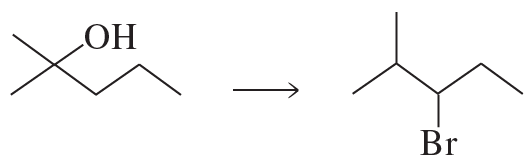
Using the given starting material and any necessary organic or inorganic reagents, indicate how the desired compounds could be synthesized:
c. Synthesis pathway showing conversion of an alcohol to a brominated compound with structural formulas.

Guida verificata passo dopo passo
1
Step 1: Analyze the starting material and the desired product. The starting material is a secondary alcohol, and the desired product is a secondary alkyl bromide. This suggests that the reaction involves the conversion of an alcohol to an alkyl halide.
Step 2: Select an appropriate reagent for converting alcohols to alkyl halides. A common reagent for this transformation is phosphorus tribromide (PBr₃), which reacts with alcohols to produce alkyl bromides.
Step 3: Write the reaction mechanism. The alcohol reacts with PBr₃, where the hydroxyl group (-OH) is replaced by a bromine atom (Br). This occurs via nucleophilic substitution (SN2 mechanism) for secondary alcohols.
Step 4: Ensure reaction conditions are suitable. The reaction with PBr₃ typically occurs under mild conditions and does not require heating. It is important to use anhydrous conditions to prevent side reactions.
Step 5: Verify the stereochemistry of the product. Since the reaction proceeds via an SN2 mechanism, inversion of configuration at the carbon center may occur. Ensure the product matches the desired stereochemistry.

Risposta video verificata per un problema simile:

Questa soluzione video è stata consigliata dai nostri tutor come utile per risolvere questo problema.
Durata del video:
5m

Concetti chiave

Ecco i concetti essenziali che devi comprendere per rispondere correttamente alla domanda.

Radical Reactions

Radical reactions involve the formation and reaction of free radicals, which are highly reactive species with unpaired electrons. In organic synthesis, these reactions can be initiated by heat or light, leading to the substitution of atoms in a molecule. For example, in the synthesis of brominated compounds, a radical initiator can abstract a hydrogen atom from an alcohol, generating a radical that can then react with bromine.
Video consigliato:
03:49
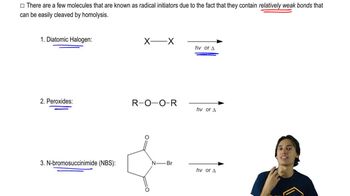
What are Radical Initiators?

Bromination of Alcohols

Bromination of alcohols typically involves converting the alcohol into a more reactive species, such as a bromide. This can be achieved through radical mechanisms where the hydroxyl group is replaced by a bromine atom. The process often requires the presence of a brominating agent, such as N-bromosuccinimide (NBS), which facilitates the substitution reaction under radical conditions.
Video consigliato:
00:54
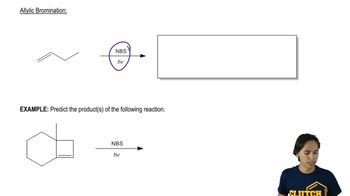
Mechanism of Allylic Bromination.

Mechanism of Substitution Reactions

Substitution reactions can occur via different mechanisms, including radical, nucleophilic, and electrophilic pathways. In the context of radical bromination, the mechanism typically involves initiation, propagation, and termination steps. Understanding these steps is crucial for predicting the outcome of the reaction, including regioselectivity and stereochemistry, which are important for synthesizing the desired brominated compound.
Video consigliato:
01:34
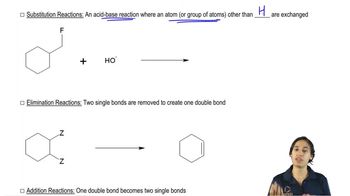
Recognizing Substitution Reactions.
Pratica correlata
Domanda del libro di testo

Using the given starting material and any necessary organic or inorganic reagents, indicate how the desired compounds could be synthesized:

a.

1275
views

Domanda del libro di testo

At 600 °C, the ratio of the relative rates of formation of a tertiary, a secondary, and a primary radical by a chlorine radical is 2.6 : 2.1 : 1. Explain the change in the degree of regioselectivity compared to what was found in Problem 44.

983
views
Domanda del libro di testo

Given that ∆H° for the reaction is -42 kcal/mol and the bond dissociation enthalpies for the C−H, C−Cl, and O−H bonds are 101, 85, and 105 kcal/mol respectively, calculate the bond dissociation enthalpy of the O−Cl bond.

1243
views
Domanda del libro di testo

Draw the products of the following reactions, including all stereoisomers:

c.

532
views
Domanda del libro di testo

A chemist wanted to determine experimentally the relative ease of removing a hydrogen atom from a tertiary, a secondary, and a primary carbon by a chlorine radical. He allowed 2-methylbutane to undergo chlorination at 300 °C and obtained as products 36% 1-chloro-2-methylbutane, 18% 2-chloro-2-methylbutane, 28% 2-chloro-3-methylbutane, and 18% 1-chloro-3-methylbutane. What values did he obtain for the relative ease of removing a hydrogen atom from tertiary, secondary, and primary hydrogen carbons by a chlorine radical under the conditions of his experiment?

1323
views
Domanda del libro di testo

Propose a mechanism for the following reaction:

825
views