

Ch. 13 - Mass Spectrometry; Infrared Spectroscopy; UV/Vis Spectroscopy
Bruice - Organic Chemistry 8th Edition
Bruice8th EditionOrganic ChemistryISBN: 9780135213711Non è quello che usi tu?Cambia libro di testo
Capitolo 13, Problema 21a(1,2)

a. Which occurs at a larger wavenumber:
1. a C=C stretch or a C=C stretch?
2. a C–H stretch or a C–H bend?

Guida verificata passo dopo passo
1
Step 1: Understand the concept of wavenumber in IR spectroscopy. Wavenumber is inversely proportional to the wavelength of light absorbed and is directly related to the energy of the vibration. Higher energy vibrations correspond to larger wavenumbers.
Step 2: Compare the bond strengths and masses of the atoms involved in the C=C stretch and C=C stretch. Stronger bonds and lighter atoms result in higher vibrational frequencies and thus larger wavenumbers.
Step 3: Analyze the C-H stretch and C-H bend. Stretching vibrations generally occur at higher wavenumbers than bending vibrations because stretching involves a direct change in bond length, which requires more energy compared to the angular deformation in bending.
Step 4: Recall typical IR absorption ranges. For example, C=C stretches typically appear around 1600-1680 cm⁻¹, while C-H stretches are found around 2800-3100 cm⁻¹. Bending vibrations for C-H are usually in the range of 600-1000 cm⁻¹.
Step 5: Conclude that the C=C stretch occurs at a larger wavenumber than the C=C stretch due to bond strength differences, and the C-H stretch occurs at a larger wavenumber than the C-H bend due to the energy required for stretching versus bending.

Risposta video verificata per un problema simile:

Questa soluzione video è stata consigliata dai nostri tutor come utile per risolvere questo problema.
Durata del video:
2m

Concetti chiave

Ecco i concetti essenziali che devi comprendere per rispondere correttamente alla domanda.

Wavenumber in Infrared Spectroscopy

Wavenumber is a measure of the frequency of a vibration in infrared spectroscopy, expressed in reciprocal centimeters (cm⁻¹). It is directly related to the energy of molecular vibrations, with higher wavenumbers corresponding to higher energy transitions. Understanding wavenumbers is essential for interpreting IR spectra and identifying functional groups in organic compounds.
Video consigliato:
Percorso guidato
2:56
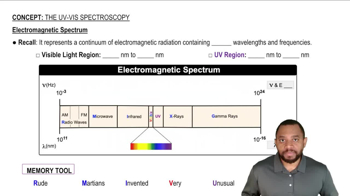
The UV-Vis Spectroscopy Concept 1

Types of Vibrational Modes

Molecules can undergo different types of vibrational motions, including stretching and bending. Stretching involves changes in bond lengths, while bending involves changes in bond angles. Recognizing these modes is crucial for predicting which vibrations will occur at higher wavenumbers, as stretching vibrations typically require more energy than bending vibrations.
Video consigliato:
03:42
Identifying Types of Stereoisomers

Comparison of C=C and C-H Vibrations

In organic compounds, the C=C double bond exhibits a stronger and more energetic stretching vibration compared to the C-H bond. Similarly, C-H stretching vibrations occur at higher wavenumbers than C-H bending vibrations. This distinction is important for analyzing IR spectra, as it helps in identifying the presence and type of functional groups in a molecule.
Video consigliato:
04:18
Ranking Shielded Protons