Ch. 14 - NMR Spectroscopy
Bruice - Organic Chemistry 8th Edition
Bruice8th EditionOrganic ChemistryISBN: 9780135213711Non è quello che usi tu?Cambia libro di testo
Capitolo 14, Problema 71b

Identify each of the following compounds from its molecular formula and its 1H NMR spectrum:
b. C6H12O
<IMAGE>

Guida verificata passo dopo passo
1
Analyze the molecular formula (C6H12O) to determine the degree of unsaturation. Use the formula: \( \text{Degree of Unsaturation} = \frac{2C + 2 - H + N - X}{2} \), where \( C \) is the number of carbons, \( H \) is the number of hydrogens, \( N \) is the number of nitrogens, and \( X \) is the number of halogens. For C6H12O, calculate \( \text{Degree of Unsaturation} = \frac{2(6) + 2 - 12}{2} = 1 \). This indicates one double bond or a ring in the structure.
Examine the 1H NMR spectrum for key features. Look for the number of signals, their chemical shifts, splitting patterns, and integration values. These provide information about the number of unique hydrogen environments, the types of hydrogens (e.g., alkyl, vinyl, hydroxyl), and their relative quantities.
Identify functional groups based on the molecular formula and NMR data. Since the formula includes oxygen, consider functional groups like alcohols, ethers, or carbonyl-containing groups (e.g., aldehydes or ketones). The degree of unsaturation suggests the possibility of a double bond or a ring structure.
Correlate the chemical shifts in the NMR spectrum with specific hydrogen environments. For example, hydrogens attached to carbons near an oxygen atom (e.g., in alcohols or ethers) typically appear in the range of \( \delta 3.0-4.5 \), while hydrogens on sp2 carbons (e.g., in alkenes) appear in the range of \( \delta 4.5-6.5 \). Analyze splitting patterns to determine connectivity.
Propose a structure that matches the molecular formula, degree of unsaturation, and NMR data. Verify that the structure accounts for all signals in the spectrum, including their chemical shifts, integrations, and splitting patterns. For example, a possible structure for C6H12O could be a cyclic ether (e.g., tetrahydropyran) or an alcohol with a double bond (e.g., 3-hexen-1-ol).

Risposta video verificata per un problema simile:

Questa soluzione video è stata consigliata dai nostri tutor come utile per risolvere questo problema.
Durata del video:
6m

Concetti chiave

Ecco i concetti essenziali che devi comprendere per rispondere correttamente alla domanda.

Molecular Formula Interpretation

The molecular formula provides essential information about the number and types of atoms in a compound. For C6H12O, it indicates the presence of six carbon atoms, twelve hydrogen atoms, and one oxygen atom. Understanding how to interpret this formula is crucial for deducing the possible structure and functional groups present in the compound.
Video consigliato:
06:06
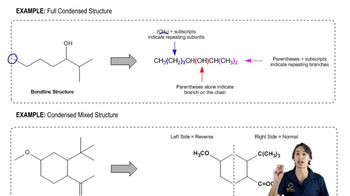
How to interpret condensed structures.

1H NMR Spectroscopy

Proton nuclear magnetic resonance (1H NMR) spectroscopy is a powerful analytical technique used to determine the structure of organic compounds. It provides information about the number of hydrogen atoms in different environments, their chemical shifts, and splitting patterns, which can help identify functional groups and the overall structure of the molecule. Analyzing the NMR spectrum is key to confirming the identity of the compound.
Video consigliato:
06:46
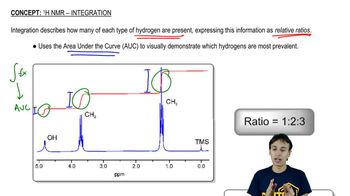
1H NMR Integration

Isomerism in Organic Compounds

Isomerism refers to the existence of compounds with the same molecular formula but different structural arrangements or spatial orientations. For C6H12O, various isomers can exist, including alcohols, ethers, and ketones. Recognizing the potential isomers is essential for accurately identifying the compound based on its molecular formula and NMR data.
Video consigliato:
01:40
Defining meso compounds.