Ch. 14 - NMR Spectroscopy
Bruice - Organic Chemistry 8th Edition
Bruice8th EditionOrganic ChemistryISBN: 9780135213711Non è quello che usi tu?Cambia libro di testo
Capitolo 14, Problema 69e

Sketch the following spectra that would be obtained for 2-chloroethanol:
e. The four parts of a DEPT 13C NMR spectrum.

Guida verificata passo dopo passo
1
Understand the DEPT 13C NMR technique: DEPT (Distortionless Enhancement by Polarization Transfer) is used to differentiate between CH3, CH2, CH, and quaternary carbons in a molecule. It involves four spectra: DEPT-45, DEPT-90, DEPT-135, and a broadband decoupled spectrum showing all carbons.
Analyze the structure of 2-chloroethanol: The molecule contains two carbons. One is a CH2 group bonded to chlorine, and the other is a CH2 group bonded to hydroxyl (-OH). There are no CH or CH3 groups in this molecule.
Interpret the DEPT spectra: In DEPT-45, all carbons with attached hydrogens (CH, CH2, CH3) appear as positive peaks. In DEPT-90, only CH carbons appear. In DEPT-135, CH and CH3 carbons appear as positive peaks, while CH2 carbons appear as negative peaks. The broadband decoupled spectrum shows all carbons, including quaternary carbons.
Sketch the DEPT spectra for 2-chloroethanol: Since the molecule contains only CH2 carbons, the DEPT-45 spectrum will show two positive peaks, the DEPT-90 spectrum will show no peaks, the DEPT-135 spectrum will show two negative peaks, and the broadband decoupled spectrum will show two positive peaks.
Compare the provided images (A, B, C, D) with the expected DEPT spectra for 2-chloroethanol: Identify the image that matches the description above, where CH2 peaks are positive in DEPT-45, negative in DEPT-135, and present in the broadband decoupled spectrum, while no peaks appear in DEPT-90.

Risposta video verificata per un problema simile:

Questa soluzione video è stata consigliata dai nostri tutor come utile per risolvere questo problema.
Durata del video:
4m

Concetti chiave

Ecco i concetti essenziali che devi comprendere per rispondere correttamente alla domanda.

DEPT NMR Spectroscopy

DEPT (Distortionless Enhancement by Polarization Transfer) NMR is a technique used to differentiate between carbon types in a molecule. It provides information about the number of hydrogen atoms attached to each carbon atom, allowing for the identification of CH3, CH2, and CH groups. This is crucial for interpreting the structure of organic compounds like 2-chloroethanol.
Video consigliato:
10:06
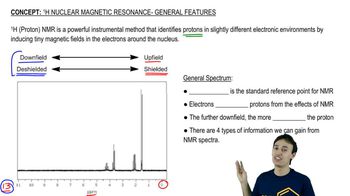
General NMR Features

Carbon Types in Organic Molecules

In organic chemistry, carbon atoms can be classified based on their bonding: CH3 (methyl), CH2 (methylene), and CH (methine). Each type has distinct NMR signals, which help in determining the molecular structure. Understanding these types is essential for accurately sketching the DEPT NMR spectrum for compounds such as 2-chloroethanol.
Video consigliato:
02:17
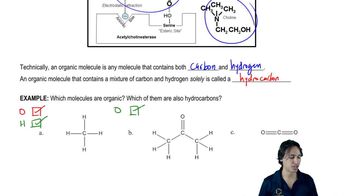
Identifying organic molecules

Interpreting NMR Spectra

Interpreting NMR spectra involves analyzing the peaks and their intensities to deduce the molecular structure. In DEPT spectra, the presence or absence of signals for different carbon types indicates how many hydrogen atoms are attached. This skill is vital for accurately sketching the DEPT spectrum for 2-chloroethanol and understanding its chemical environment.
Video consigliato:
10:06
General NMR Features