
Ch. 17 - Reactions at the Alpha-Carbon
Bruice - Organic Chemistry 8th Edition
Bruice8th EditionOrganic ChemistryISBN: 9780135213711Non è quello che usi tu?Cambia libro di testo
Capitolo 17, Problema 79

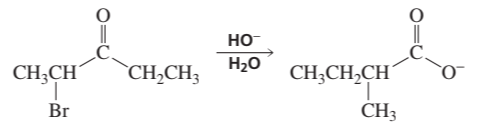
A carboxylic acid is formed when an a-haloketone reacts with hydroxide ion. This reaction is called a Favorskii reaction. Propose a mechanism for the following Favorskii reaction. (Hint: In the first step, HO- removes a proton from the a-carbon that is not bonded to Br; a three-membered ring is formed in the second step; and HO- is a nucleophile in the third step.)
Favorskii reaction mechanism showing a-haloketone converting to a carboxylic acid with hydroxide ion.

Guida verificata passo dopo passo
1
Step 1: The hydroxide ion (HO⁻) acts as a base and removes a proton from the α-carbon that is not bonded to the bromine atom. This deprotonation generates a carbanion intermediate at the α-carbon.
Step 2: The carbanion intermediate undergoes intramolecular nucleophilic attack on the carbonyl carbon, forming a three-membered cyclic intermediate known as a cyclopropanone.
Step 3: The bromine atom is expelled from the cyclopropanone intermediate, resulting in the formation of a new carbanion at the α-carbon adjacent to the carbonyl group.
Step 4: The hydroxide ion (HO⁻) acts as a nucleophile and attacks the carbonyl carbon of the intermediate, leading to the opening of the three-membered ring and formation of a tetrahedral intermediate.
Step 5: The tetrahedral intermediate undergoes proton transfer, resulting in the formation of the carboxylic acid product with the hydroxide ion regenerating as the leaving group.

Risposta video verificata per un problema simile:

Questa soluzione video è stata consigliata dai nostri tutor come utile per risolvere questo problema.
Durata del video:
6m

Concetti chiave

Ecco i concetti essenziali che devi comprendere per rispondere correttamente alla domanda.

Favorskii Reaction

The Favorskii reaction is a rearrangement reaction involving α-haloketones that leads to the formation of carboxylic acids. In this reaction, a hydroxide ion (HO-) acts as a base and nucleophile, facilitating the conversion of the α-haloketone into a carboxylic acid through a series of steps, including deprotonation and ring formation.
Video consigliato:
05:09
Heck Reaction

Nucleophilic Attack

Nucleophilic attack is a fundamental concept in organic chemistry where a nucleophile, which is an electron-rich species, attacks an electron-deficient center, typically a carbon atom in a carbonyl group. In the Favorskii reaction, the hydroxide ion acts as a nucleophile, attacking the electrophilic carbon in the three-membered ring formed during the reaction, leading to the final product.
Video consigliato:
08:27
Nucleophilic Addition

Three-Membered Ring Formation

The formation of a three-membered ring, often referred to as an epoxide or cyclic intermediate, is a key step in many organic reactions, including the Favorskii reaction. This intermediate is formed when a nucleophile attacks an electrophilic carbon, resulting in a cyclic structure that can stabilize the transition state and facilitate further reactions, ultimately leading to the desired product.
Video consigliato:
05:14
Ring Expansion