Ch. 17 - Reactions at the Alpha-Carbon
Bruice - Organic Chemistry 8th Edition
Bruice8th EditionOrganic ChemistryISBN: 9780135213711Non è quello che usi tu?Cambia libro di testo
Capitolo 17, Problema 76a,b,c

A student tried to prepare the following compounds using aldol condensations. Which of these compounds was she successful in synthesizing? Explain why the other syntheses were not successful.
Structures of three compounds labeled A, B, and C, with a question about successful synthesis via aldol condensation.

Guida verificata passo dopo passo
1
Step 1: Understand the aldol condensation reaction. Aldol condensation involves the reaction of an enolate ion (formed from an aldehyde or ketone) with another carbonyl compound, followed by dehydration to form an α,β-unsaturated carbonyl compound. The reaction requires the presence of α-hydrogens in the starting material.
Step 2: Analyze compound A. Compound A is an α,β-unsaturated aldehyde, which can be successfully synthesized via aldol condensation. The starting materials could be acetaldehyde reacting with itself under basic conditions.
Step 3: Analyze compound B. Compound B is an α,β-unsaturated ketone. This compound can also be synthesized via aldol condensation. The starting materials could be acetone reacting with itself under basic conditions.
Step 4: Analyze compound C. Compound C is an α,β-unsaturated aldehyde with a cyclohexyl group. This compound can be synthesized via aldol condensation using cyclohexanone and acetaldehyde as starting materials. The reaction proceeds successfully because both starting materials have α-hydrogens.
Step 5: Analyze compound D and E. Compound D is an α,β-unsaturated aldehyde with a cyclohexyl group, but it has steric hindrance due to the bulky substituents, making the reaction less favorable. Compound E is an α,β-unsaturated ketone with a branched structure, which may also face steric hindrance or difficulty in enolate formation. These factors could prevent successful synthesis via aldol condensation.

Risposta video verificata per un problema simile:

Questa soluzione video è stata consigliata dai nostri tutor come utile per risolvere questo problema.
Durata del video:
3m

Concetti chiave

Ecco i concetti essenziali che devi comprendere per rispondere correttamente alla domanda.

Aldol Condensation

Aldol condensation is a reaction between aldehydes or ketones that contain alpha-hydrogens, leading to the formation of β-hydroxy aldehydes or ketones. This reaction involves the nucleophilic addition of an enolate ion to a carbonyl compound, followed by dehydration to form an α,β-unsaturated carbonyl compound. Understanding this mechanism is crucial for predicting which compounds can be synthesized through this method.
Video consigliato:
09:51
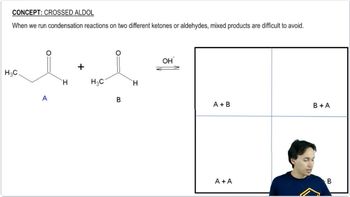
Crossed Aldol

Enolate Ion Formation

Enolate ions are formed when a base abstracts an alpha-hydrogen from a carbonyl compound, resulting in a resonance-stabilized anion. The stability of the enolate ion is influenced by the structure of the carbonyl compound and the presence of substituents. The ability to form a stable enolate is essential for successful aldol condensation, as it determines the reactivity of the starting materials.
Video consigliato:
02:26
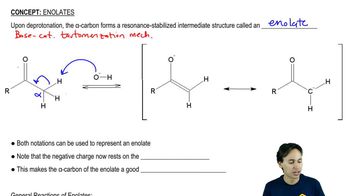
Formation of Enolates

Steric Hindrance

Steric hindrance refers to the repulsion between bulky groups in a molecule that can impede reactions. In the context of aldol condensation, steric hindrance can affect the accessibility of the carbonyl carbon to nucleophiles, thus influencing the reaction's feasibility. Compounds with significant steric hindrance may not undergo aldol condensation effectively, leading to unsuccessful syntheses.
Video consigliato:
02:53
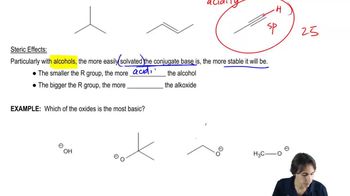
Understanding steric effects.