Ch. 17 - Reactions at the Alpha-Carbon
Bruice - Organic Chemistry 8th Edition
Bruice8th EditionOrganic ChemistryISBN: 9780135213711Non è quello che usi tu?Cambia libro di testo
Capitolo 17, Problema 25b

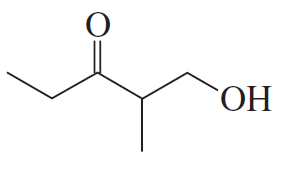
Describe how the following compounds can be prepared using an aldol addition in the first step of the synthesis:
b. Chemical structure of an aldol product featuring a hydroxyl group and a carbonyl group.

Guida verificata passo dopo passo
1
Step 1: Identify the target molecule and recognize the functional groups present. The compound contains a β-hydroxy ketone, which is a typical product of an aldol addition reaction.
Step 2: Determine the two starting materials required for the aldol addition. The β-hydroxy ketone suggests that the reaction involves a ketone and an aldehyde. The ketone group comes from acetone (CH3COCH3), and the aldehyde group comes from benzaldehyde (C6H5CHO).
Step 3: Write the mechanism for the aldol addition reaction. In the presence of a base (e.g., NaOH), acetone undergoes enolate formation. The enolate ion then attacks the carbonyl carbon of benzaldehyde, forming a new C-C bond.
Step 4: After the aldol addition, the intermediate formed is an alkoxide ion. This intermediate is protonated to yield the β-hydroxy ketone product.
Step 5: Verify the structure of the product to ensure it matches the target molecule. The product should have the β-hydroxy ketone functional group and the aromatic ring from benzaldehyde.

Risposta video verificata per un problema simile:

Questa soluzione video è stata consigliata dai nostri tutor come utile per risolvere questo problema.
Durata del video:
2m

Concetti chiave

Ecco i concetti essenziali che devi comprendere per rispondere correttamente alla domanda.

Aldol Addition

Aldol addition is a fundamental reaction in organic chemistry where two carbonyl compounds, typically aldehydes or ketones, react in the presence of a base to form a β-hydroxy aldehyde or ketone. This reaction involves the nucleophilic attack of an enolate ion on the carbonyl carbon of another molecule, leading to the formation of a new carbon-carbon bond. The resulting product can undergo dehydration to yield an α,β-unsaturated carbonyl compound.
Video consigliato:
09:51
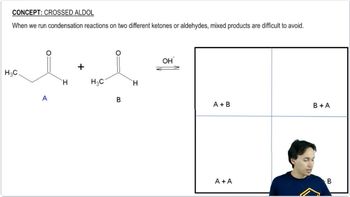
Crossed Aldol

Enolate Ion Formation

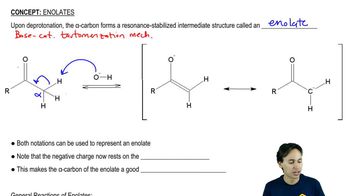
Enolate ions are key intermediates in aldol reactions, formed when a carbonyl compound is deprotonated at the alpha carbon by a base. This results in a resonance-stabilized anion that can act as a nucleophile in subsequent reactions. The stability of the enolate ion is influenced by the structure of the carbonyl compound and the strength of the base used, making it crucial for the efficiency of the aldol addition process.
Video consigliato:
02:26
Formation of Enolates

Dehydration of Aldol Products

After the aldol addition step, the β-hydroxy carbonyl compound can undergo dehydration, where a molecule of water is eliminated, resulting in the formation of an α,β-unsaturated carbonyl compound. This step is often driven by the stability of the resulting conjugated system and can be facilitated by heat or acid/base conditions. The dehydration product is typically more reactive and can participate in further reactions, making it an important aspect of synthetic pathways.
Video consigliato:
09:51
Crossed Aldol