Ch. 17 - Reactions at the Alpha-Carbon
Bruice - Organic Chemistry 8th Edition
Bruice8th EditionOrganic ChemistryISBN: 9780135213711Non è quello che usi tu?Cambia libro di testo
Capitolo 17, Problema 26

What two carbonyl compounds are required for the synthesis of morachalcone A, via a Claisen–Schmidt condensation?
<IMAGE>

Guida verificata passo dopo passo
1
Understand the Claisen–Schmidt condensation: This reaction involves the condensation of an aldehyde or ketone with another carbonyl compound in the presence of a base to form an α,β-unsaturated carbonyl compound. Typically, one of the reactants lacks an α-hydrogen to prevent self-condensation.
Analyze the structure of morachalcone A: Morachalcone A is a chalcone, which is an α,β-unsaturated ketone. It has a conjugated system with a double bond between the α and β carbons and a ketone group on the β carbon. Identify the two fragments that could combine to form this structure.
Determine the aromatic aldehyde: The aromatic ring attached to the α-carbon in morachalcone A suggests that one of the starting materials is an aromatic aldehyde. Identify the specific aldehyde based on the substituents on the aromatic ring in morachalcone A.
Determine the ketone: The ketone group in morachalcone A indicates that the second starting material is a ketone. The structure of morachalcone A will help you identify the specific ketone required for the reaction.
Combine the two carbonyl compounds: Write the reaction mechanism for the Claisen–Schmidt condensation, showing the base-catalyzed deprotonation of the ketone to form an enolate ion, followed by nucleophilic attack on the aldehyde, and finally dehydration to form the α,β-unsaturated ketone (morachalcone A).

Risposta video verificata per un problema simile:

Questa soluzione video è stata consigliata dai nostri tutor come utile per risolvere questo problema.
Durata del video:
3m

Concetti chiave

Ecco i concetti essenziali che devi comprendere per rispondere correttamente alla domanda.

Claisen–Schmidt Condensation

The Claisen–Schmidt condensation is a reaction between an aldehyde and a ketone in the presence of a base, leading to the formation of an α,β-unsaturated carbonyl compound. This reaction involves the nucleophilic attack of the enolate ion derived from one carbonyl compound on the carbonyl carbon of the other, followed by dehydration. Understanding this mechanism is crucial for identifying the specific carbonyl compounds needed for synthesizing morachalcone A.
Video consigliato:
02:10
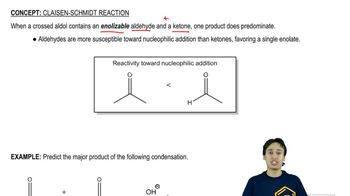
Claisen-Schmidt Reaction

Carbonyl Compounds

Carbonyl compounds are organic molecules that contain a carbon atom double-bonded to an oxygen atom (C=O). They include aldehydes, ketones, and carboxylic acids, each with distinct reactivity patterns. In the context of the Claisen–Schmidt condensation, recognizing the types of carbonyl compounds involved is essential for predicting the products and understanding the synthesis of complex molecules like morachalcone A.
Video consigliato:
01:40
Defining meso compounds.

Morachalcone A

Morachalcone A is a specific type of flavonoid compound known for its biological activity and potential therapeutic applications. Its synthesis often involves strategic reactions, such as the Claisen–Schmidt condensation, to construct its carbon skeleton. Identifying the correct carbonyl precursors is vital for successfully synthesizing morachalcone A and understanding its structural features and functions.