Ch. 17 - Reactions at the Alpha-Carbon
Bruice - Organic Chemistry 8th Edition
Bruice8th EditionOrganic ChemistryISBN: 9780135213711Non è quello che usi tu?Cambia libro di testo
Capitolo 17, Problema 36a

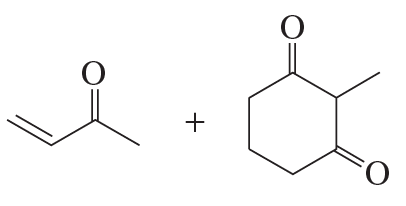
Draw the product obtained by heating each pair of ketones in a basic solution.
a. Two ketone structures are shown, indicating a reaction with a plus sign between them.

Guida verificata passo dopo passo
1
Step 1: Recognize that the problem involves the aldol condensation reaction, which occurs when ketones (or aldehydes) are treated with a base and heat. This reaction forms a β-hydroxyketone intermediate, which can dehydrate to form an α,β-unsaturated ketone as the final product.
Step 2: Identify the α-hydrogens in each ketone. These are hydrogens attached to the carbon adjacent to the carbonyl group. These hydrogens are acidic and can be deprotonated by the base to form an enolate ion.
Step 3: Write the enolate ion formation for one of the ketones. The base abstracts an α-hydrogen, leaving behind a negatively charged carbon adjacent to the carbonyl group. Represent this enolate ion using resonance structures to show delocalization of the negative charge.
Step 4: Show the nucleophilic attack of the enolate ion on the carbonyl carbon of the second ketone. This forms a new carbon-carbon bond, resulting in a β-hydroxyketone intermediate.
Step 5: Apply heat to the β-hydroxyketone intermediate. Heating promotes dehydration (loss of water), leading to the formation of an α,β-unsaturated ketone as the final product. Draw the structure of the product, ensuring the double bond is between the α and β carbons.

Risposta video verificata per un problema simile:

Questa soluzione video è stata consigliata dai nostri tutor come utile per risolvere questo problema.

Concetti chiave

Ecco i concetti essenziali che devi comprendere per rispondere correttamente alla domanda.

Ketones

Ketones are organic compounds characterized by a carbonyl group (C=O) bonded to two carbon atoms. They are commonly represented by the general formula R2C=O, where R can be any alkyl or aryl group. Understanding the structure and reactivity of ketones is essential for predicting the products formed during chemical reactions, especially under different conditions such as heating or in the presence of a base.
Video consigliato:
02:27
Name the ketone

Base-Catalyzed Reactions

Base-catalyzed reactions involve the use of a base to facilitate the reaction process, often by deprotonating a molecule to form a more reactive species. In the context of ketones, bases can promote reactions such as aldol condensation, where two ketones react to form a β-hydroxy ketone. Recognizing the role of the base is crucial for understanding the mechanism and the resulting products of the reaction.
Video consigliato:
01:57
Base Catalyzed

Aldol Condensation

Aldol condensation is a reaction where two carbonyl compounds, typically aldehydes or ketones, react in the presence of a base to form a β-hydroxy carbonyl compound, which can further dehydrate to yield an α,β-unsaturated carbonyl compound. This reaction is significant in organic synthesis as it allows for the formation of larger, more complex molecules from simpler ones. Understanding this process is key to predicting the products when heating ketones in a basic solution.
Video consigliato:
09:51
Crossed Aldol