Ch. 17 - Reactions at the Alpha-Carbon
Bruice - Organic Chemistry 8th Edition
Bruice8th EditionOrganic ChemistryISBN: 9780135213711Non è quello che usi tu?Cambia libro di testo
Capitolo 17, Problema 38a,b

Which of the following compounds will decarboxylate when heated?
a. Two chemical structures of carboxylic acid derivatives, one with a hydroxyl group, illustrating decarboxylation.
b. Chemical structure of two carboxylic acid derivatives, illustrating potential decarboxylation when heated.

Guida verificata passo dopo passo
1
Step 1: Understand the concept of decarboxylation. Decarboxylation is a chemical reaction in which a carboxylic acid group (-COOH) is removed from a molecule, releasing carbon dioxide (CO₂). This reaction typically occurs when a compound contains a β-keto acid structure, where a ketone group is located at the β-position relative to the carboxylic acid group.
Step 2: Analyze compound (a). The first image shows a molecule with a carboxylic acid group (-COOH) and a ketone group at the β-position relative to the carboxylic acid. This structure is a β-keto acid, which is known to undergo decarboxylation when heated.
Step 3: Analyze compound (b). The second image shows a molecule with two ketone groups but no carboxylic acid group. Since decarboxylation requires the presence of a carboxylic acid group, this compound will not undergo decarboxylation.
Step 4: Compare the two compounds. Compound (a) has the necessary β-keto acid structure for decarboxylation, while compound (b) does not have a carboxylic acid group and therefore cannot decarboxylate.
Step 5: Conclude that compound (a) will decarboxylate when heated, while compound (b) will not undergo decarboxylation.

Risposta video verificata per un problema simile:

Questa soluzione video è stata consigliata dai nostri tutor come utile per risolvere questo problema.
Durata del video:
47s

Concetti chiave

Ecco i concetti essenziali che devi comprendere per rispondere correttamente alla domanda.

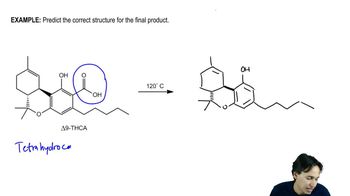
Decarboxylation

Decarboxylation is a chemical reaction that involves the removal of a carboxyl group (-COOH) from a molecule, resulting in the release of carbon dioxide (CO2). This process is commonly observed in organic compounds, particularly carboxylic acids and their derivatives, when heated or treated with certain reagents. Understanding the conditions under which decarboxylation occurs is crucial for predicting the behavior of specific compounds during heating.
Video consigliato:
02:32
Predict the correct structure

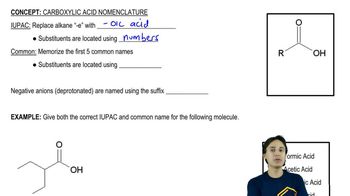
Carboxylic Acids

Carboxylic acids are organic compounds characterized by the presence of one or more carboxyl groups (-COOH). They are known for their acidic properties and can undergo various reactions, including decarboxylation. Recognizing the structure and reactivity of carboxylic acids is essential for determining which compounds may decarboxylate upon heating, as not all carboxylic acids will do so under the same conditions.
Video consigliato:
04:20
Carboxylic Acids Nomenclature

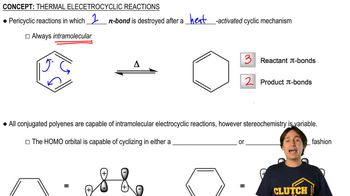
Thermal Stability

Thermal stability refers to the ability of a compound to withstand heat without undergoing decomposition or significant chemical change. In the context of decarboxylation, the thermal stability of a compound influences whether it will decarboxylate when heated. Factors such as molecular structure, substituents, and the presence of stabilizing or destabilizing groups play a critical role in determining the likelihood of decarboxylation during heating.
Video consigliato:
06:36
MO Theory of Thermal Electrocyclics