Ch. 17 - Reactions at the Alpha-Carbon
Bruice - Organic Chemistry 8th Edition
Bruice8th EditionOrganic ChemistryISBN: 9780135213711Non è quello che usi tu?Cambia libro di testo
Capitolo 17, Problema 16a

How could each of the following compounds be prepared from cyclohexanone?
a.

Guida verificata passo dopo passo
1
Step 1: Analyze the target compound. The target compound is a ketone with a butyl group attached to the alpha-carbon of cyclohexanone. This suggests an alkylation reaction at the alpha-carbon of cyclohexanone.
Step 2: Identify the reagent needed for alkylation. To introduce a butyl group, you would use a butyl halide (e.g., 1-bromobutane or 1-chlorobutane) as the alkylating agent.
Step 3: Prepare cyclohexanone for alkylation. Cyclohexanone must first be converted into its enolate form. This can be achieved by treating cyclohexanone with a strong base such as sodium hydride (NaH) or lithium diisopropylamide (LDA). The base deprotonates the alpha-carbon, forming the enolate ion.
Step 4: Perform the alkylation reaction. The enolate ion reacts with the butyl halide in an SN2 mechanism, where the halide is displaced, and the butyl group is attached to the alpha-carbon of cyclohexanone.
Step 5: Purify the product. After the reaction is complete, the mixture can be purified using techniques such as distillation or chromatography to isolate the desired compound.

Risposta video verificata per un problema simile:

Questa soluzione video è stata consigliata dai nostri tutor come utile per risolvere questo problema.
Durata del video:
4m

Concetti chiave

Ecco i concetti essenziali che devi comprendere per rispondere correttamente alla domanda.

Cyclohexanone Structure and Reactivity

Cyclohexanone is a cyclic ketone with a six-membered carbon ring and a carbonyl group (C=O). Its structure makes it a versatile intermediate in organic synthesis, allowing for various reactions such as nucleophilic addition and oxidation. Understanding its reactivity is crucial for determining how to convert it into other compounds.
Video consigliato:
01:17
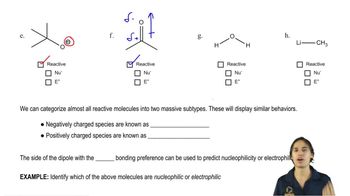
Reactivity of Molecules

Nucleophilic Addition Reactions

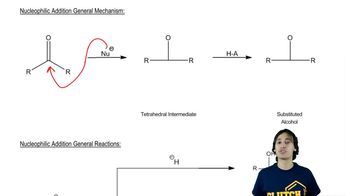
Nucleophilic addition reactions involve the attack of a nucleophile on the electrophilic carbon of a carbonyl group. In the case of cyclohexanone, nucleophiles can add to the carbonyl carbon, leading to the formation of alcohols or other functional groups. This concept is essential for synthesizing derivatives from cyclohexanone.
Video consigliato:
08:27
Nucleophilic Addition

Functional Group Transformations

Functional group transformations refer to the chemical reactions that convert one functional group into another. In organic synthesis, these transformations are key to modifying compounds like cyclohexanone into desired products. Familiarity with common reactions, such as reduction, oxidation, and substitution, is necessary for planning the synthesis of target compounds.
Video consigliato:
02:36
Identifying Functional Groups