Ch. 17 - Reactions at the Alpha-Carbon
Bruice - Organic Chemistry 8th Edition
Bruice8th EditionOrganic ChemistryISBN: 9780135213711Non è quello che usi tu?Cambia libro di testo
Capitolo 17, Problema 16b

How could each of the following compounds be prepared from cyclohexanone?
b.

Guida verificata passo dopo passo
1
Step 1: Analyze the target compound. The given compound is an α,β-unsaturated ketone derived from cyclohexanone. This structure suggests the presence of a conjugated double bond adjacent to the carbonyl group.
Step 2: Identify the reaction type. To prepare an α,β-unsaturated ketone from cyclohexanone, an aldol condensation reaction is typically used. This involves the formation of a β-hydroxy ketone intermediate followed by dehydration to form the conjugated double bond.
Step 3: Choose the appropriate reagent. To achieve the desired transformation, cyclohexanone can be reacted with acetaldehyde (CH₃CHO) in the presence of a base such as NaOH or KOH. The base facilitates the enolate formation from cyclohexanone, which then reacts with acetaldehyde.
Step 4: Describe the mechanism. The reaction proceeds as follows: (a) Cyclohexanone forms an enolate ion under basic conditions. (b) The enolate ion attacks the carbonyl carbon of acetaldehyde, forming a β-hydroxy ketone intermediate. (c) Under heating or continued basic conditions, the β-hydroxy ketone undergoes dehydration to yield the α,β-unsaturated ketone.
Step 5: Verify the product. The final product matches the target compound, with the conjugated double bond adjacent to the cyclohexanone ring. This confirms the successful application of the aldol condensation reaction.

Risposta video verificata per un problema simile:

Questa soluzione video è stata consigliata dai nostri tutor come utile per risolvere questo problema.
Durata del video:
4m

Concetti chiave

Ecco i concetti essenziali che devi comprendere per rispondere correttamente alla domanda.

Cyclohexanone Structure and Reactivity

Cyclohexanone is a cyclic ketone with a six-membered carbon ring and a carbonyl group (C=O). Its structure makes it a versatile intermediate in organic synthesis, allowing for various reactions such as nucleophilic addition and oxidation. Understanding its reactivity is crucial for determining how to convert it into other compounds.
Video consigliato:
01:17
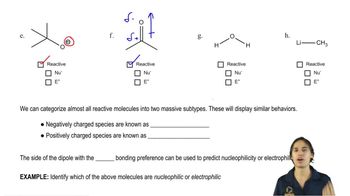
Reactivity of Molecules

Nucleophilic Addition Reactions

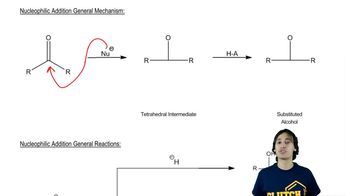
Nucleophilic addition reactions involve the attack of a nucleophile on the electrophilic carbon of a carbonyl group. In the case of cyclohexanone, this can lead to the formation of alcohols or other functional groups depending on the nucleophile used. Mastery of this concept is essential for synthesizing desired products from cyclohexanone.
Video consigliato:
08:27
Nucleophilic Addition

Functional Group Transformations

Functional group transformations are chemical reactions that convert one functional group into another, allowing for the modification of organic compounds. In the context of cyclohexanone, understanding how to perform these transformations, such as reduction or oxidation, is key to preparing various derivatives from the starting material.
Video consigliato:
02:36
Identifying Functional Groups